
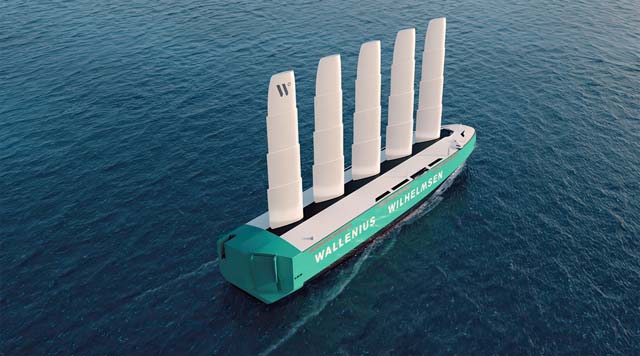
Wallenius Wilhemsen Acting CEO and CFO Torbjørn Wist recently presented the ‘Orcelle Wind’ concept to The Crown Princess of Sweden, Victoria, The Crown Prince of Norway, Haakon Magnus and Prince Daniel of Sweden at an event in Gothenburg.
With Orcelle Wind, Wallenius Wilhelmsen aims for up to 90% emissions reduction compared to the best current vessels. The ship will be a full-size ro-ro ship with a capacity of 7,000 car equivalent units (CEU). At 220m long and a height to the top of its wing sails of around 100m – depending on ultimate sail design – it would be the largest sailing vessel in the world. If all goes to plan, the first Orcelle Wind would enter service in 2026.
The idea was first introduced in 2005 and set down a marker that Wallenius Wilhelmsen has been working towards ever since.
Wist said: “Thanks to technological advances, regulatory developments and increased customer focus on emissions, we can see a path from concept to a bold and ambitious new reality. Taking the initiative now is of paramount importance to us – it is what best secures our growth and prosperity for the future. At Wallenius Wilhelmsen we are proud of the contribution we have made. However, we also understand that in continuing our role, we must also do our part in combating climate change.”
Wallenius Wilhelmsen believes that wind power can be a compelling option once again. Making Orcelle Wind a reality will require new thinking on how to manage the transport of vehicles from factories to dealers on the other side of the world.
Wist continued: “I am therefore delighted to announce that one of our top customers and world-leading car producers, Volvo Cars, is ‘onboard’ as a partner with the Orcelle Wind initiative.”
The ship will be about 220m long, 39.4m beam, and the 7000 CEU capacity will be above average for the company’s fleet, loaded via a 150t stern ramp. The ‘wing’ sails will be essentially vertically mounted aircraft wings, which will generate greater force, be more robust and will be easier to control than the conventional alternative. – The wing sails, which will be produced in composite material and will be computer controlled, will fold down for bridge clearance but will not be telescopic. Orcelle Wind will achieve roughly 12 knots under wind power alone, but will have a auxiliary propulsion system for higher speeds, port navigation and adverse weather. The type of auxiliary propulsion has not been finalised