
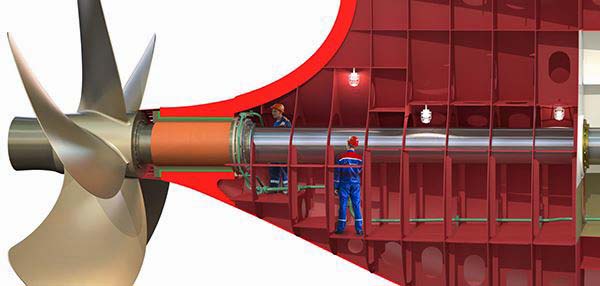
ABS has granted Approval in Principle (AIP) to the Shanghai Merchant Ship Design and Research Institute (SDARI) for a new vessel design with a novel aft layout, which is claimed to eliminate pollution and promote efficient vessel operations.
The SDARI design, developed in cooperation with the National Technical University of Athens (NTUA) and Thordon Bearings, introduces a new approach to the vessel’s aft layout, including removal of the stern tube casting, employing seawater for lubrication and creation of a chamber to permit in-water maintenance for the first time. These innovations enable shipyards and owners to eliminate shaft-bearing oil leaks, simplify maintenance and reduce costs.
Using seawater for lubrication of the stern tube bearing removes the risk of oil leakage. By enabling engineers and shipyard craftsmen to access the stern tube without the need for drydocking, the off-hire time incurred for bearing inspection and replacement will shrink from two weeks to one day while afloat.
The installation of an appropriate torsional vibration damper can eliminate the Barred Speed Range, which is present in the vast majority of direct-drive diesel engine vessels. Therefore, the new design can better support simplified compliance with environmental-focused regulations, such as the Energy Efficiency Existing Ship Index (EEXI), and can enable more efficient use of the engine’s propulsive power, since the whole RPM range of speeds is available for continuous operation. It enables owners to easily consider an Engine Power Limitation (EPL) if required, to comply with Carbon Intensity Indicator (CII) power output requirements.
The resulting design proposal complies with all ABS rules and regulations and the tail shaft survey can be maintained at the maximum 15-year interval if the ABS TCM-W Notation is adopted.
Dr Chris Leontopoulos, Director of Global Ship Systems Centre, ABS Athens, said: “The concept of using seawater as a lubricant is well-established and the proposed design takes this further by removing the stern tube casting, decreasing the shaft line length, reducing the engine room space and increasing the cargo space. The elimination of the Barred Speed Range and the creation of an aft chamber to enable in-water inspection, enable significant efficiencies and cost savings for operators.”
Wang Gangyi, Chief Engineer, SDARI, added: “Besides the benefits for operators, the new concept also gives more possibilities and flexibility for designers to optimize the engine room arrangement. Consequently, for the shipbuilding, the initial cost including the construction materials and labor cost may be reduced accordingly. It will contribute a series of benefits to all parts involved in the vessel.”
Anthony Hamilton, Technical Director, Thordon Bearings, concluded: “Our technical discussions have led to a revolutionary propeller shaft bearing system design that offers easy monitoring and maintenance of bearing and seal condition without shaft withdrawal, lower operational expenses and elimination of oil emissions forever.”