
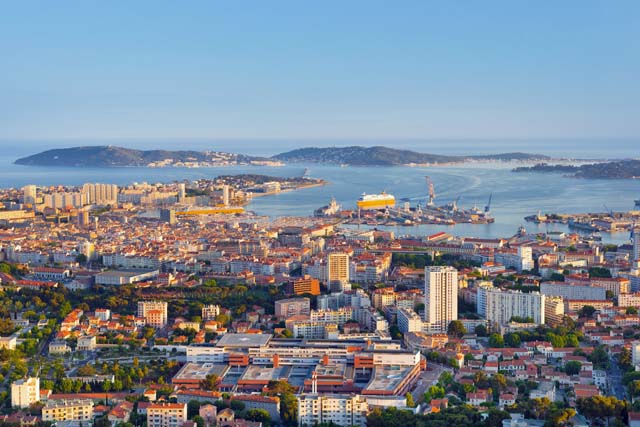
ABB is leading a consortium formed to provide shore-to-ship power connection for ferries and cruise ships in the Port of Toulon, which will be future-proofed with an onshore energy storage system which manages fluctuations in energy demand of the local grid and draws on emerging renewable energy sources .
The aim of the project is to cut emissions and noise during port stays. The Port of Toulon, which handles over 1.6 million ferry and cruise passengers annually, has around 1,300 yearly calls from ferries and cruise vessels right in the heart of the city. The port is central to the ‘Zero-smoke stopovers’ plan by the region of Provence-Alpes-Côte d’Azur (Région Sud PACA), which aims to electrify the docks of Toulon, Marseille and Nice to enable emission-free stays for vessels.
Shore-to-ship power connections allow ships to turn off diesel generators during port calls. For shipowners, this means savings on fuel and maintenance costs while switching to cleaner and more sustainable energy. Cruise and ferry passengers, as well as local residents benefit not only from cleaner air, but also from less noise and vibrations generated when ships are docked.
Hubert Falco, President, Toulon Provence Méditerranée Metropolis, said: “Toulon is the first Mediterranean port to supply power to all of its docks. This is an innovative project built on an intelligent energy flow management system with a unique energy mix. With the support of ABB as well as the Région Sud PACA and our partners, we are significantly improving air quality in the port, while maintaining business activity. The shore-to-ship power connection will eliminate more than 80% of pollutant emissions. It will also save 9,000 hours of vessels running on diesel annually. For the ferry activity in the city of Toulon alone, this adds up to a reduction in sulphur emissions equivalent to those of 50,000 cars in a year.”
Frédéric Mestivier, designer and technical director of the power project for the Toulon Provence Méditerranée Metropolis, added: “Technically, this project is developing a new, intelligent smart grid power network using digital technology to manage energy flows from several interconnected sources. The infrastructure makes it possible to optimize overall energy efficiency while limiting the carbon footprint.”
ABB is leading the consortium selected to manage and execute this turnkey project, with commissioning due in 2023. The ABB solution will be capable of delivering enough energy to cover the needs of three ferries calling to port simultaneously, or one cruise ship. Vessels will have the possibility of 50 or 60Hz power connections. As part of the consortium, Eiffage Construction will carry out the civil engineering work, and Fauché will be responsible for installing and connecting the equipment.
Through the innovative design established by the Toulon Provence Méditerranée Metropolos, the system implemented with ABB equipment will have the ability to automatically adjust the energy ē mix to supply vessels through the local power network (Enedis), with solar energy produced from a photovoltaic shelter, as well as an energy storage system made up of lithium batteries. The system will help smooth consumption peaks while allowing the storage of excess solar energy production. It will also be able to use other renewable energy sources such as fuel cells, as they become available.
Head of Service, ABB Marine and Ports Jyri Jusslin said: “We are honoured to have been selected by Toulon Provence Méditerranée Metropolis to work on this innovative project. We commend the Toulon authorities for grasping this opportunity. It sets a course for a more sustainable future with smart systems that already exist today.”
Sustainable transportation, including marine and inland vessels, will play an important role in the goal set by France to achieve carbon neutrality by 2050 in accordance with the climate plan announced in 2017. Worldwide, ferries transport around 4bn passengers and 370m vehicles every year, according to trade association Interferry. IMO has adopted a strategy to reduce annual emissions by at least 40% by 2030 and 70% by 2050, and passenger transport is under pressure to achieve these targets.