
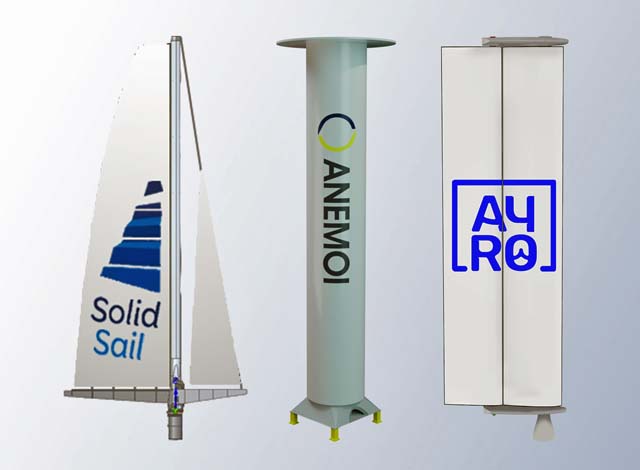
Dutch research organisation Marin, joined a consortium including Core IC, SSPA, Ayro, Chantiers de l’Atlantique, Flikkema Innovation Management & Consultancy, Wartsila Netherlands, Universita Degli Studi di Genova, Euronav and Anemoi Marine Technologies, has begun the Optiwise EU-funded research and innovation project aiming to improve and demonstrate energy savings using wind propulsion and hydrodynamic improvements in propulsion of commercial vessels.
The EU call requested solutions for energy savings of at least 10% for single measures and 20% for combined measures. In response, the Optiwise consortium defined the its ambition, to develop and employ holistic design and control methods for ground-breaking new ship concepts utilising wind propulsion while considering realistic operational scenarios. These methods are expected to realise average energy savings between 30% and 50% when compared to equivalent conventional ships while ensuring operational feasibility in a realistic wind climate.
Konstantinos Papoutsis of Euronav said: “We are aware of the huge challenge that the maritime industry is facing to reduce its Green House Gas emissions according to the IMO ambition, and the gradually introduced regulations to advance this effort. Zero emission fuels are assumed to be the main solution. However, sufficient and affordable supply of such fuels is highly uncertain for the foreseeable future, which means that energy saving on board is expected to be increasingly important, both environmentally and economically. We expect that the knowledge built through such R&D efforts will benefit the waterborne industry in its decarbonisation journey.”
Rogier Eggers, Project Manager, Marin, added: “Fruitful and promising progress has been made with the introduction of new devices to the market, with some 15-plus ships sailing commercially with wind propulsion in the world fleet. Wind propulsion is so far mostly applied without re-considering the overall ship design and operations. Whereas that fits within a ‘business as usual’ scenario, it does limit the attainable savings. With Optiwise we are building on R&D already under development among the consortium partners in the last years and re-thinking the design process and energy management of ships with wind propulsion, while still making sure that these ships conform to common operational and regulatory requirements. We thereby expect to enable and showcase much higher savings than what can be seen in the present market applications.”
The Optiwise project will pursue its objectives through close inspection of three operational use cases: a bulk carrier with Anemoi Rotor Sails; a tanker with Ayro OceanWings; and a passenger vessel with Chantiers de l’Atlantique solid sail. These cases will provide a relevant sample of the world fleet, such that the methods developed in the project should cover the majority of the seagoing shipping fleet. While the wind propulsion type is preselected for each ship type, the exact implementation and change of the ship design and energy management is fully open to further performance enhancement.
The project scope involves extensive simulations where disciplines such as aerodynamics, hydrodynamics and routing and energy management are holistically brought together. Attention will be applied to ensure realistic operational applications of the developed designs. Thus, these will be complemented with basin tests to assess manoeuvring and seakeeping, bridge simulations to assess crew operation, and land-based wind propulsion tests to verify better control.
The project will deliver open guidelines for integrated system optimisation with wind propulsion, and smart measurement and control for best operation. The guidelines will be demonstrated in experimental model tests, bridge simulations and measurements on a full scale land based wind propulsion unit.