
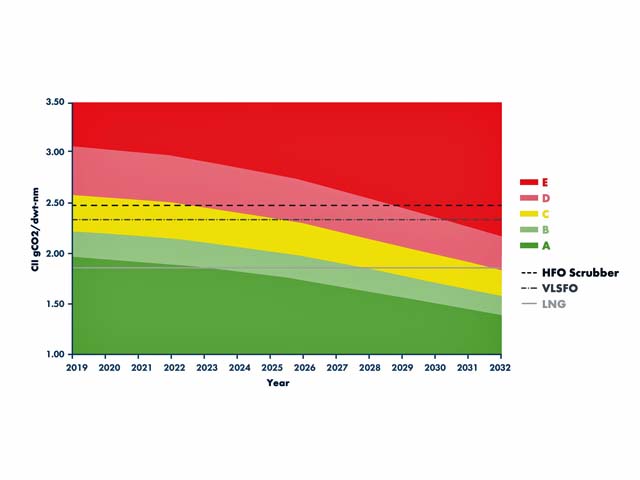
According to new analysis from industry coalition Sea-LNG, liquefied natural gas will provide the best fuel option for owners considering how to extend vessel life and secure CII compliance through retrofit.
The coalition finds significant benefits to a business choosing an LNG retrofit over fuelling with VLSFO or retrofitting an HFO vessel with scrubbers, based on a 10-year payback period.
Increasingly stringent environmental regulations are expected to drive down the CII grades for existing ships and will have a detrimental effect on charter rates for those powered using fuel oil. The financial viability of vessels that are just a few years old will be under severe threat if significant action to reduce emissions, such as an alternative fuel retrofit, is not taken.
Sea-LNG’s latest analysis looks at the investment performance of three two-stroke propulsion options. These were evaluated to compare the most cost-effective solutions available for ship owners: a current VLCC sailing on VLSFO; a retrofitted VLCC sailing with scrubbers on HFO; a retrofitted VLCC sailing on LNG. The tool allows users a ‘Readers’ Choice’ to compare fuel prices which generate the same investment returns for each possible investment decision.
Sea-LNG GM Adi Aggarwal said: “The climate emergency we face is a stock problem, and a flow problem. By choosing to retrofit their existing vessels, owners will be able to reduce GHG emissions now and over the remaining lifetime of the vessel, keeping GHGs from entering the atmosphere. Retrofitting vessels provides a faster and cheaper route to the lower emission fuels that are essential to reduce shipping emissions. As alternative fuels and regulations progress, it’s important that we re-evaluate previous investments. LNG retrofits now have a strong business case.”
Retrofitting vessels to use LNG fuel helps to future proof vessels, reducing costs and improving returns. For owners, modernising a ship through retrofit can be carried out more quickly than building a new vessel. New vessels typically take around two years to build. Accessing and scheduling work with a retrofit yard is often easier, as they have more capacity than newbuild yards. Retrofitting can be arranged as part of a scheduled drydock call for a VLCC, meaning out of service time is reduced across the entire project.
Adopting LNG fuel on a VLCC is believed to improve CII ratings substantially, giving and maintaining a one to two grade improvement over alternatives throughout the remaining lifetime of the vessel. The gap in ratings between LNG and HFO scrubber or VLSFO retrofit options provides a commercial chartering financial advantage to owners who choose the LNG pathway.
According to Sea-LNG, LNG is a safe, mature, commercially viable marine fuel offering superior emissions performance, significant GHG reduction benefits and a pragmatic pathway to a zero-emissions shipping industry. With drop in bio-LNG or synthetic gas, LNG-fuelled vessels are future-proofed, enabling compliance with GHG reduction targets as the shipping industry moves towards its 2050 emissions goal.