
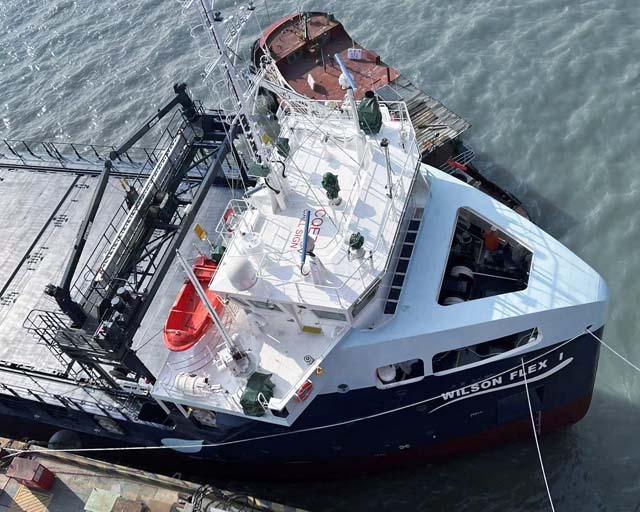
The first ship of a new ‘Hanse Eco’ class of coastal vessels operated by the Rhenus-Arkon-Shipinvest shipping company has now been handed over by the shipyard. The ‘Wilson Flex I’ has now started its voyage from China to Europe via South Korea.
Rhenus-Arkon-Shipinvest says it is pressing ahead to provide sustainable short-sea traffic by means of the new ships. The joint venture between logistics company Rhenus and Arkon Shipping has developed five vessels in all. Thanks to their newly designed and optimised hull shape, they save about 20% in fuel compared to traditional ships. The CO2 and particulate matter emissions are significantly lower too. The Hanse Eco class vessels are equipped with support from an electric motor and a waste gas treatment unit. As a result, they already meet the IMO Tier III emissions standard, which will be compulsory for new vessels from 2025 onwards.
Claimed benefits of the optimised design include the possibility of travelling ‘open top’ without any hatch covers. The end-to-end deck also makes it possible to transport large quantities of particularly bulky goods. The arrangement at the front guarantees that the bridge still has an unobstructed view, even when the deck is being loaded. Torsten Westphal, of Arkon Shipping, said: “Now that the ‘Wilson Flex I‘ has been handed over, we have taken a significant step along the way to having a sustainable fleet. We’re setting a particularly high standard in this project and it is definitely historic for European shipping.”
Ralf Uebachs, MD Rhenus-Arkon-Shipinvest, added: “Our new Hanse Eco ships represent a milestone when it comes to sustainability. They have extremely modern equipment and have been conceived with a completely new, forward-looking design. We are therefore starting a new chapter in ecological short-sea shipping.”
The ‘Wilson Flex I’ is almost 90m long, has a total payload capacity of up to 4,200t and is operated by seven crew members. It is now on its way from China as the first of five identical vessels, and will take on board its basic cargo. The next stop is the port of Yeosu in South Korea, where a European crew will go on board and navigate the vessel to Europe. On arrival, it will be handed over to long-term charterer, Norwegian shipping company, Wilson ASA. It is expected to arrive in Europe in about one-and-a-half months.
The new ships will operate on European short-sea traffic routes – ranging from the Baltic Sea and North Sea to the Mediterranean and the Black Sea. Following the first delivery, completed vessels will set off from China every six to eight weeks.