
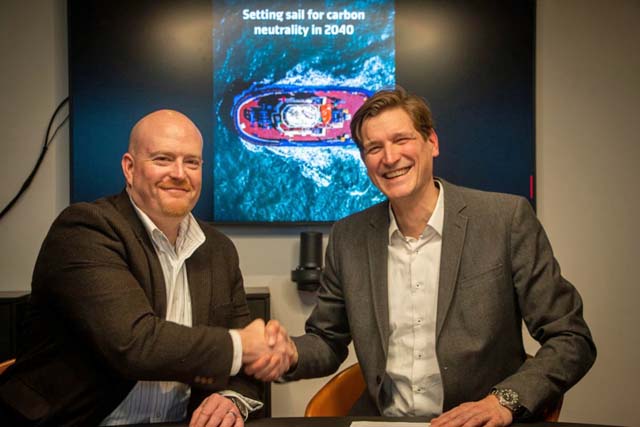
Caterpillar Marine and towage operator Svitzer have signed a Memorandum of Understanding (MoU) to adopt solutions that enable Svitzer to use methanol in its tug fleet.
The implementation of dual-fuel methanol engines focuses on new tugs as well as conversions of existing Cat-powered tugs, which comprise the majority of Svitzer’s fleet. With a relationship spanning several decades, this agreement marks the next evolution of Svitzer’s journey to, amongst other initiatives such as the adoption of biofuels in EcoTow, enable the fulfillment of its decarbonisation strategy.
Following the recent Cat 3500-E series methanol-readiness announcement in September 2022, this MoU formalises the collaboration to deploy engine technologies that enable Svitzer to use methanol, which can be produced from renewable energy sources to reduce lifecycle greenhouse gas emissions.
Svitzer COO Kasper Karlsen said: “Svitzer has a significant fleet of vessels powered by Cat systems, as well as ambitious decarbonisation targets for our future fleet. It is therefore of utmost importance that we join forces with strategic collaborators, such as Caterpillar Marine, to find solutions for both existing and future vessels.”
With a focused strategy on sustainability, Svitzer is making pragmatic decisions to support reductions in carbon intensity in the maritime industry, aiming to achieve a 50% reduction in the CO2 intensity of its entire fleet by 2030 and become CO2 neutral across all scopes by 2040.
Brad Johnson, Caterpillar Marine VP and GM marine said: “Many companies within the industry are exploring methods and solutions that can be incorporated today while also determining viable options for the future. The collaboration between Caterpillar and Svitzer is an important step towards implementing the solutions that support their decarbonisation strategy.”
Gareth Prowse, head of decarbonisation, Svitzer, added: “Given the size and complexity of our fleet and the ambitious target we have set of becoming carbon neutral in 2040, it is critical to take a holistic approach to reducing our CO2 emissions. While we seek to mature and utilise new technologies, fuel types and operational approaches for new vessels, we also have to find solutions that help reduce the emissions from our existing fleet. The support Caterpillar provides in finding ways of converting our equipment to methanol usage plays a key role in this.”
Andres Perez, global tug segment manager, Caterpillar Marine, concluded: “The focus of our collaboration is two-fold. We are supporting Svitzer to enable tugs to operate on methanol with diesel-like performance while providing fuel flexibility which is key to enabling operators to lower their carbon intensity via green methanol as availability increases. Additionally, we’re taking full advantage of the learnings to provide conversion solutions for the existing fleet. This is a critical aspect to reach the level of methanol adoption that Svitzer seeks to fulfil their goals.”