
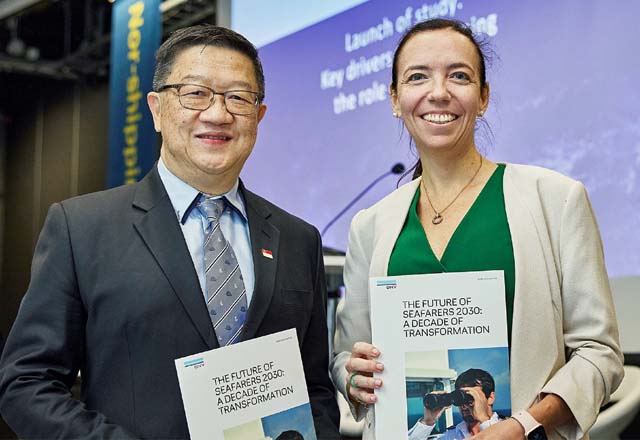
DNV, with co-sponsor Singapore Maritime Foundation (SMF), has published a study examining the key drivers transforming the maritime industry and their impact on ship management and seafarers.
The research draws on a comprehensive methodology combining a literature review, expert consultations, and a survey of over 500 seafarers responsible for operating dry bulk, tanker, and container vessels globally. Of the many forces shaping the future of maritime, decarbonisation and digitalisation were identified to have the most profound impact on the future of seafarers and ship management leading up to 2030.
81% of seafarers surveyed indicated that they require either partial or complete training to effectively work with the advanced technology that will be present onboard future ships. Similarly, over 75% of respondents expressed a requirement for partial or complete training on new fuel types such as LNG, batteries or synthetic fuels. This training deficit rose to 87% of survey respondents for emerging fuels such as ammonia, hydrogen and methanol.
As shipowners and operators are increasingly deploying modern technologies onboard and exploring the use of alternative fuels in a bid to stay compliant, the handling of incoming fuels and technologies will require the crew to have additional skill sets and thus the need for comprehensive training. At the same time, growing automation of components and systems onboard is expected to bring about a rise in autonomous and smart ships, thus the need to consider remote shore monitoring in the future.
Cristina Saenz de Santa Maria, DNV Regional Manager South East Asia, Pacific and India, Maritime said: “With decarbonisation and digitalisation rapidly transforming the maritime landscape, it is essential that shipowners and managers understand the new challenges and opportunities that these forces present. Proper training and industry collaboration will be imperative to ensure seafarers are equipped with the competence and skills to operate ships using new fuels and technologies in a safe and efficient manner. Upskilling seafarers will not only enable them to execute additional monitoring and maintenance tasks onboard but can also be leveraged upon to improve attraction and retention in the industry.”
SMF Chairman Hor Weng Yew said: “The work that we do this decade is important and complements the efforts of the shipping community to meet the net-zero target in 2050. It is essential that we begin by understanding where the competency gaps are, areas of training most needed, and then work as an industry to equip sea-going professionals with the transition and future skills needed to safely and effectively operate the new-fuelled types of ships that are coming into service.”
Following the research results, the study recommends seafarer training to be prioritised for fuels that are most likely to be predominant in the current decade, capitalising on the ease of accessibility and range of modern training methods to improve skill deficits. It was also found that career advancement and development opportunities for seafarers will improve with the trend towards decarbonisation and digitalisation, complemented by the expected prevalence of complementary shore-based roles in the future.