
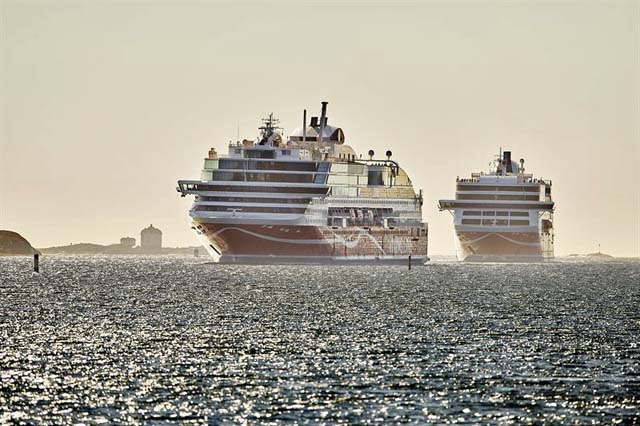
Finnish company Viking Line’s focused environmental work, which began in the 1980s, is being highlighted as once again showing the way for the entire shipping industry, with the company now offering passengers on its Turku-Åland-Stockholm route the option of purchasing renewable biofuel in proportion to the amount of fuel used for their journey and thus reduce the emissions from their travel by up to 90%.
European biogas, produced from waste materials, is being delivered by the Nordic energy company Gasum to the climate-smart vessels Viking Glory and Viking Grace. Passengers on the Turku-Åland-Stockholm route can now purchase biogas in proportion to the amount of fuel used for their journey. On a cruise between Turku and Stockholm, the additional price is less than €5. At that price, passengers reduce their carbon footprint by up to 90% compared to a trip where fossil-derived LNG is used. The amount of liquefied biogas (LBG) purchased is based on average fuel use per passenger.
Dani Lindberg, Sustainability Manager Viking Line said: “This really is an important milestone in our more than 40-year journey towards sustainability. We are the first shipping company on the Baltic Sea to offer passengers the option of reducing their carbon footprint by replacing LNG with renewable biofuel. Many of our passengers have asked for such an option, and we are really pleased that we can now engage them even more in our work for the environment and the Baltic Sea.”
Viking Glory and Viking Grace were planned for preparation to run on biogas and synthetic fuels produced from renewable energy. Viking Glory was launched in service in 2022 and Viking Grace in 2013. Normally, the vessels run on LNG, which is also considered a low-emission energy source compared to oil-based fuels. NOx emissions from LNG are 85% lower than when using oil-based fuels, which helps counter eutrophication (nutrient enrichment) and acidification of the Baltic Sea. For humans, practically no sulphur emissions or particulate matter is generated using the fuel. The switch to biofuel in turn will especially reduce GHG emissions.
In biogas production, waste streams such as food and agricultural waste are used as raw materials, which promotes a circular economy. Viking Line is issued a sustainability certificate for every biogas delivery, which specifies where and how the gas was produced. The method used to produce the gas affects the ultimate amount of emissions. In practical terms, Viking Line purchases biogas with the additional funds paid by passengers. The biogas used for fuel on board is mixed with LNG.
Lindberg said: “Our investments totalling €450m in the climate-smart Viking Glory and Viking Grace have enabled the use of liquefied natural gas, and now biogas is being introduced. Working for the environment requires vision, engagement and significant investments in new technology. The supply of biogas is still limited compared to demand. For example, all biogas produced in Finland is currently used in manufacturing. We will now work in partnership with Gasum and our environmentally-aware customers to increase the use of biogas.”
Viking Line is currently taking part in projects that explore the possibilities of creating a carbon-neutral green corridor for the Baltic Sea. Biogas has already been tested as a fuel on Viking Grace.
Jan Hanses, President and CEO Viking Line said: “Through our project work and partnership for the sustainable maritime transport of the future, we have gained a great deal of knowledge and information to support our own sustainability work. Carbon-neutral maritime transport still lies in the future, but it is no longer a utopian dream. Our goal at Viking Line is to be among the first when the time comes.”