
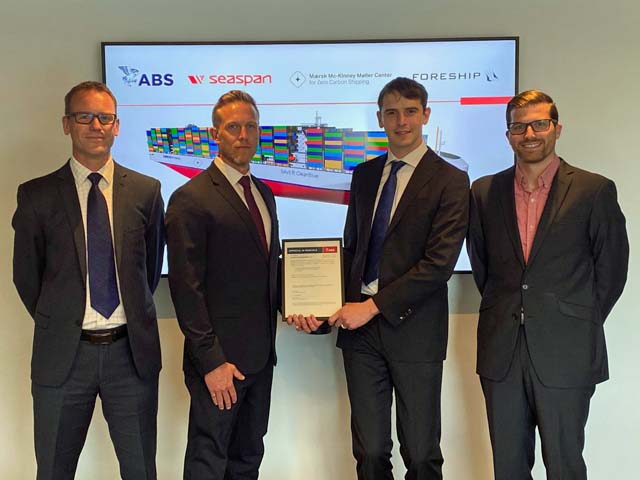
Classification society American Bureau of Shipping (ABS) awarded Approval in Principle (AiP) for the design of a 15,000 TEU ammonia-powered container vessel.
The certificates were presented to Seaspan Corporation and the Mærsk Mc-Kinney Møller Center for Zero Carbon Shipping (MMMCZCS) in collaboration with ship designer Foreship.
Ammonia is considered a promising alternative marine fuel. However, there are currently no ships capable of sailing on ammonia. In 2022, Seaspan and the MMMCZCS jointly initiated a project to better understand the challenges and opportunities of designing a large ammonia-fueled container vessel. A concept design for a 15,000 TEU container vessel was developed in close collaboration with Foreship and ABS. The project included defining the safety objective, impact of ammonia as a fuel on vessel performance, completion of a hazard identification (Hazid) qualitative risk assessment and development of the concept design. Documentation included a fuel range and endurance analysis, ammonia tank and system location assessments, general arrangement, main machinery and electrical system design, and initial vessel stability calculations.
The project is connected to the Singapore Ammonia Bunkering Feasibility Study (SABRE) consortium, focusing on developing and demonstrating an ammonia supply chain in Singapore. Phase 1 performed an end-to-end technical and commercial feasibility study of ammonia bunkering in Singapore along with a preliminary ammonia bunkering vessel design. Phase 2 is investigating how to mature the commercial feasibility so that contractual terms across the supply chain are prepared and can be executed to establish an ammonia bunkering operation in Singapore. The 15,000 TEU vessel was designed as a potential receiver of ammonia fuel from bunker vessels currently under design and development.
Peter Jackson, SVP Assets and Technology, Seaspan Corporation, said: “This is a very good example of industry collaboration, where leading maritime organisations are working together and taking tangible steps to decarbonise the maritime industry. Ammonia is a very promising future marine fuel and this project is a vital and significant step in the development and realisation of ammonia powered containerships.”
Thomas McKenney, Head of Ship Design MMMCZCS, added: “This project highlights the importance of collaborative design development and proper safety case integration as the ammonia fuel pathway matures for the maritime industry.”
Panos Koutsourakis, ABS VP Global Sustainability said: “This landmark vessel is an important step towards helping ship owners and operators benefit from ammonia’s zero-carbon tank-to-wake emissions profile. However, ABS recognises that ammonia presents a specific set of safety and technology challenges, and we are committed to leading the industry in supporting its safe adoption at sea.”
Shaun White, MD UK Foreship concluded: “Foreship has a clear strategy and focuses on decarbonisation services and supporting the marine industry to achieve net zero targets. This innovative project demonstrates how Foreship works in collaboration with ship owners, classification societies and research organisations applying industry-leading naval architecture and marine engineering expertise to ship designs using promising alternative fuels.”
A report detailing the concept design, how the ammonia safety case was developed and outcomes from the risk assessment will be published by MMMCZCS. The potential commercialisation of the vessel design concept based on technology and shipyard readiness will be the focus of the next stage of the project.