
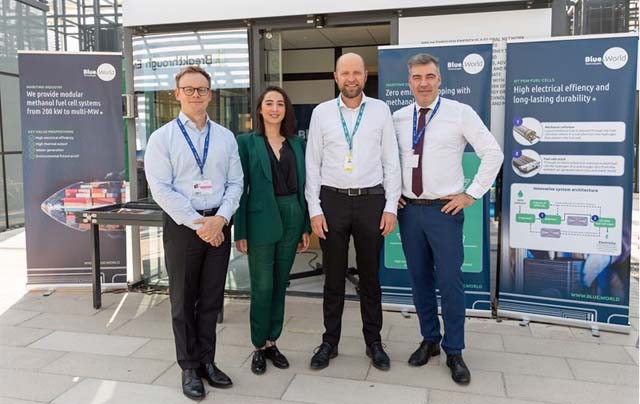
Danish fuel cell company Blue World Technologies says it is on a voyage towards supporting net-zero shipping, and with Maersk Growth, A.P. Moller-Maersk’s venture arm, the Cycle Group and the Export and Investment Fund of Denmark (EIFO) participating in a financing round, the company has taken yet another step towards providing multi-megawatt fuel cell solutions.
As shipping is seen as hard to abate, there is a need for green fuels and new technologies to reach the targeted climate goals. The Blue World methanol fuel cells enable efficient conversion of methanol to electricity with electrical efficiency of up to 65%. Furthermore, fuel cells provide the potential for internal waste heat utilisation to optimise the methanol-reforming process and for additional energy recovery that can be used onboard, improving the total system efficiency.
Blue World’s patent-pending system architecture enables a reduction in fuel consumption of 20-30% paving the way for a reduction in the green premium related to fuelling with e-fuels. The fuel cell system architecture provides an opportunity for 100% capture of the generated CO₂ with a fuel increase of only 2-3% enabling attractive recycling business models. Blue World Technologies has built a fuel cell factory in Aalborg, Denmark, ensuring in-house production of all the core fuel cell components alongside system development and manufacturing.
Anders Korsgaard, Co-founder and CEO Blue World Technologies, said: “Maersk has taken the lead on decarbonising the shipping industry showing courage and determination to make a difference. But most importantly, they act. We are therefore extremely proud to have them on board in this financing round. “We are also very pleased that Maersk is joined by The Export and Investment Fund of Denmark, Cycle Group, and other new and existing shareholders in Blue World, and we are thrilled about their continuous endorsement of our company and the journey we are on”.
A.P. Moller – Maersk has set an ambition for its entire business including its fleet of around 700 container vessels to reach net zero emission in 2040. The company has recently received its first green methanol-enabled vessel Laura Maersk and has another 24 vessels capable of sailing on green methanol on order for delivery in the coming years. On top of the venture investment in Blue World, Maersk has ordered a methanol fuel cell pilot system for auxiliary power developed by Blue World to be installed on one of the Maersk’s methanol-powered container ships on order. The system is subject to being class-approved by ABS.
A.P. Moller–Maersk VP Fleet Technology Ole Graa Jakobsen said: “At Maersk we see methanol fuel cells as an interesting and promising technology. With well above 100 methanol enabled vessels on order across the industry, the demand for green fuel is rising. The prospect of fuel cell technology to significantly improve energy efficiency for these expensive green fuels could become an important component in closing the price gap to conventional bunker fuel and enable the green transition of shipping.”
EIFO CEO Peder Lundquist said: “The global green transformation of our society is an enormous task that requires more than just wind turbines. One next step is decarbonisation of the transport sector with its fuel-demanding cars, trucks, planes, ships etc. Some of this can be handled by electrification. But certain hard to abate sectors such as heavy road transport, aviation, and shipping require the development of sustainable fuels. Our task is to find the technologies of the future and help them getting quickly from the very early stages to scaling and making transformative technologies at industrial scale and thus also at a lower cost point than seen before. That´s why this makes much sense to EIFO.”
Blue World methanol fuel cells are based on high-temperature PEM technology which is highly resistance to impurities making it suitable for combining with methanol reforming. They offer potential for waste heat utilisation where part of the waste heat from the fuel cell is used to drive the process of reforming methanol and thereby optimising the total system efficiency. Furthermore, waste heat can also be used for additional energy recovery. When powered by renewable methanol, the system has a net-zero operation, while the system is ready for carbon capture, allowing for CO2 to be recycled. The system is a scalable modular configuration, firstly aiming to replace conventional fossil-based gensets, but later also provided as large multi-megawatt fuel cell-based propulsion systems.