
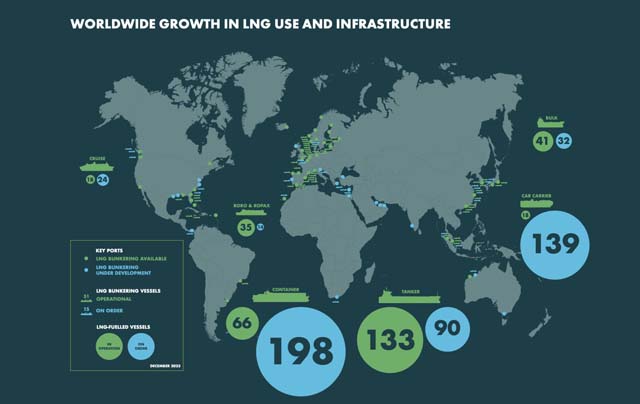
LNG industry collective Sea-LNG has published its ‘View from the Bridge 2023-2024’, its overview of LNG as a marine fuel which highlights how the shipping industry has advanced along the LNG pathway to decarbonisation in 2023 and outlines the progress anticipated in 2024.
The document includes data, infographics and facts about the LNG pathway.
Peter Keller, Chairman, Sea-LNG said: “During 2023 attitudes towards decarbonisation shifted from theoretical discussions about what might work tomorrow to what works today and how much does it cost”
According to Sea-LNG, the reality of the magnitude of the decarbonisation challenge has started to hit home for many in the maritime industry. From 1 Jan 2024, there remain only 312 months – 1,356 weeks or 9,497 days – until 2050, when shipping must achieve its net-zero target. Regulations such as the IMO’s CII (effective from 2023), the inclusion of shipping into EU ETS (2024) and FuelEU Maritime (2025) are putting immediate and growing pressure and added costs on ship owners and operators in relation to their GHG emissions. How to meet these goals with practical, realistic and safe solutions in 312 short months is a dilemma the industry must address in a concerted and coordinated manner.
The overview hopes to shine a light on some of the grey areas from alternative fuel discussions in 2023 and important considerations for 2024. There is a growing awareness of the fact that all the alternative fuels being discussed today share the same generic pathway: from fossil to bio-derived fuels, (or blue fuels using carbon capture and storage) and eventually to electro-fuels produced from renewable electricity. There is also a recognition that all these fuels are currently fossil, also known as grey.
The use of grey methanol, grey ammonia and grey hydrogen as marine fuels may well generate more GHG emissions than the traditional marine fuels they are looking to replace. This means they are not viable solutions for decarbonisation even in the short term. By contrast, grey LNG offers an immediate reduction in GHG emissions of up to 23%, after accounting for methane slip, for the two-stroke engines which are fitted to the vessels that move most of the world’s shipping tonnage.
Consequently, the methanol, ammonia and hydrogen used by shipping will need to be green, or at least a blend with large volumes of green fuels, simply to achieve parity with VLSFO (Very Low Sulphur Fuel Oil) and comply with regulations such as FuelEU Maritime.
With scaling green fuel supply a clear barrier to decarbonisation, Sea-LNG says we must make efficient use of scarce resources. With practicality in mind, we must recognise that fuel availability is linked to the scale of supply infrastructure. Acknowledging these truths, the LNG pathway from LNG to bio-LNG to e-LNG can clearly represent a practical and realistic pathway to net-zero shipping emissions.
The full report can be read here.
Image credit: Sea-LNG