
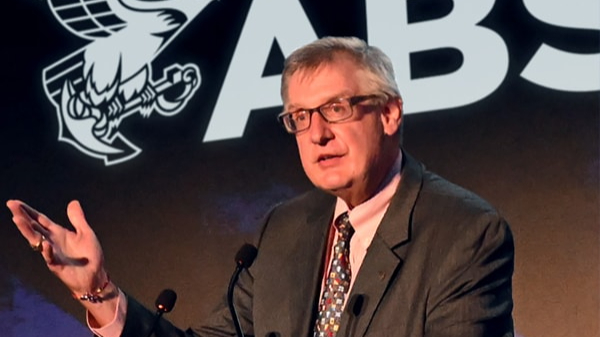
ABS Chairman and CEO Christopher J Wiernicki has endorsed nuclear energy as a legitimate, practical, and scalable solution for a wide range of strategic uses in maritime applications.
Wiernicki, speaking at the Core Power Argo Conference in Athens, Greece, said: “It is a credible long-term solution, not simply because of its potential to reduce emissions, but because it offers unmatched energy density, reliability, and strategic independence. Across the maritime and energy sectors, the pieces are coming together: advanced reactor technologies, robust Class rules, purpose-built testing facilities, evolving regulatory frameworks, and a growing appetite for public-private partnerships. Feasibility studies are underway. Investment interest is growing. And the timeline – once uncertain – is now coming into focus. And in maritime applications, we now see a clear roadmap: This journey begins with shoreside applications – powering ports and producing hydrogen – and moves offshore through floating data centres, synthetic fuel platforms, desalination systems, and ultimately domestic nuclear-powered commercial vessels and then the global fleet.”
A joint development project between ABS, Core Power and Athlos, is preparing for floating nuclear power plant deployment in the Mediterranean, identifying viable sites across islands, ports, and coastal communities.
Wiernicki continued: “Applications based on maritime assets will begin with floating power barges because they will be more straightforward to design, build, and operate. Because these types of applications will be based in a single location at a time, the regulatory approvals required may be easier to achieve compared to vessels operating across multiple geographies and jurisdictions. Floating nuclear-powered data centres are a prime example of this opportunity. By 2050, we anticipate that floating nuclear-powered data centres could capture up to 10% of the global market. In the US alone, this would mean nine total facilities. While the market cap is still evolving, projections estimate the total data centre market volume will reach US$ 212bn by 2029. This is not a niche opportunity; it is a strategic growth vector.”
ABS says that commercial nuclear corridors will be key to the adoption of nuclear propulsion.
Wiernicki said: “Vessels powered by small modular reactors are likely to operate initially on narrowly defined corridors between two countries with favourable acceptance of nuclear power and with mature regulatory oversight agencies. Commercial nuclear corridors can be the foundational infrastructure we need to unlock the full potential of nuclear technology in commercial shipping, enabling safe deployment, regulatory alignment, and scalable integration across energy, data, and logistics ecosystems.”
Image: ABS Chiarman and CEO Christopher J Wiernicki (ABS)