
An ‘E-Fuels in the Shipping Industry’ survey, conducted by market researcher mo’web and commissioned by Accelleron, has identified huge potential and key challenges that ship owners and operators face as they deploy alternative fuels to meet industry targets of climate neutrality by 2050.
The survey, involving 200 maritime decision-makers, concludes that renewable energy will be more important to shipping’s climate goals than any other fuel feedstock. Around 93% of maritime companies see e-fuels – potentially climate-neutral fuels made using renewable electricity – as making a decisive contribution to more sustainable shipping. A similar number (92%) believe e-fuels can make a significant contribution to reducing shipping’s global CO2 emissions, outranking alternatives including biofuels (69%), LNG (60%), fossil-derived hydrogen (52%) and fossil fuels combined with carbon capture (32%).
The survey of high-level executives from Germany, the Netherlands, Belgium and Spain found that the biggest group of respondents (44%) expect availability of e-fuels to remain poor before 2030, although almost all were confident that supply concerns will be addressed by 2050. To improve the availability of e-fuels, more than half (58%) of the respondents call for government incentives and subsidies for the production of e-fuels. 40% of shipping companies also complain about insufficient regulatory framework conditions and a lack of political support for the introduction of e-fuels.
The survey also shows that the implementation of e-fuels in shipping is seen as technically complex by the majority (82%) of companies. However, companies with higher annual turnover are less concerned. Besides lack of availability (46%), high switching costs (50%) and infrastructural problems (43%) are the most frequently cited obstacles to the implementation of e-fuels.
Despite the challenges, two-thirds of the companies currently see a competitive advantage through the use of e-fuels. Almost half of respondents already have concrete plans to invest in their use. For the majority (60%), retrofitting existing ships to run on alternative fuels is considered the best medium-term strategy for decarbonisation, and 36% are already planning technical retrofits for their ships.
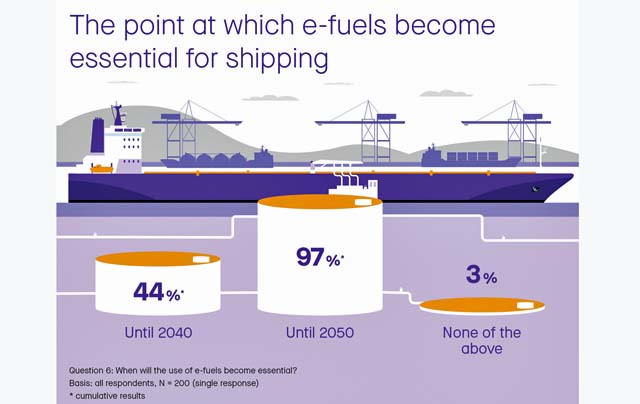
To prepare for the use of e-fuels, shipping companies currently rely most frequently (47%) on internal training. In addition, 41% are looking for strategic partnerships with e-fuel providers. As a result of all shipping’s stringent 2050 target and the high impact of e-fuels in achieving that goal, three quarters of companies surveyed expect to be unable to do without e-fuels by 2045 at the latest.
Daniel Bischofberger, CEO Accelleron said: “Accelleron’s goal is to drive decarbonisation in the maritime and energy sectors – and we are on the right track. Our survey highlights the great potential of e-fuels for the future of shipping, but we are only at the beginning. The cross-sector focus in the industry and among legislators must now quickly shift to building the right infrastructure for better availability and the right government incentives to achieve long-term cost parity between fossil fuels and e-fuels.”