
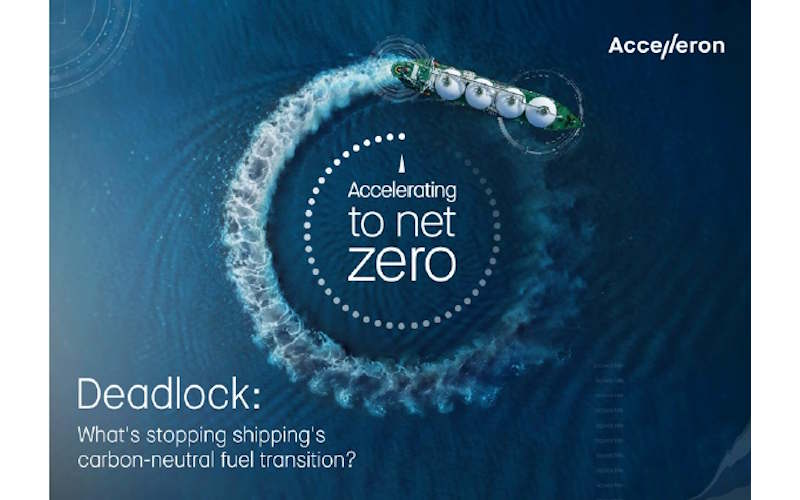
A report into maritime decarbonisation by turbocharge company Accelleron calls on the shipping industry to join the global hydrogen economy by working with other sectors to pool demand for carbon-neutral fuels.
In its first report on maritime decarbonisation, Accelleron’s Deadlock: What’s Stopping Shipping’s Carbon-Neutral Fuel Transition? argues that ‘viral’ efficiency measures such as vessel retrofits and digital solutions across the largest ships in the global fleet should be enough to reach the IMO’s carbon reduction targets for 2030. But for deeper decarbonisation leading to net zero, shipping will need to switch to green hydrogen-based fuels, which today are scarce and prohibitively expensive. Their production is virtually non-existent, despite the fact that the technology to power ships with carbon neutral fuels exists, and moreover, has been backed by major shipowners who have ordered hundreds of new vessels.
The report asks why has the shipping industry reached this impasse? And how to resolve it? Using comparative data modelling and extensive insights from dozens of senior executives across the industry, the conclusion is that shipping alone cannot solve the problem.
To kickstart ample production of affordable carbon neutral fuels, shipping needs to aggregate demand with other hard-to-abate sectors such as the steel, fertilizer and power generation industries. Rather than competing for carbon neutral fuels, as many narratives assume, these industries could join forces to transform competition into critical mass of demand, lowering the risk for mega hydrogen projects and allowing them to attract sufficient financing. This means the fate of shipping is tied to the broader, cross-sector energy transition. It means shipping should view maritime decarbonisation through the lens of the fledgling global hydrogen economy.
Daniel Bischofberger, Accelleron CEO, said: “It is clear from our research and analysis, and from the contributions of the many stakeholders who were good enough to share their expertise and insights for this report, that reaching net zero is not only about fuels or systems, but about forging a new paradigm of partnership. Fortunately, partnership has always been one of shipping’s great virtues. For thousands of years, shipping has connected cultures, carried science and progress across oceans, and overcome impossible odds through pragmatism, determination, and solidarity. As an industry, we have already proven, in a relatively short time, that we can prepare our global fleet for a decarbonised world. Now, it is time to partner with other sectors to secure the fuels we all need to carry us, finally, to that net zero shore.”
The report finds that:
- Technical and operational efficiency measures could cut emissions by over 30% by 2030, exceeding the IMO target.
- By 2050, shipping alone will need 100–150m tons of green hydrogen each year
- Shipping, aviation, steel, cement, power, and agriculture account for about 70% of global emissions and would need a total of around 500m tons of green hydrogen and US$ 9trn in cumulative investment to produce it.
- Only about 38m tons of green hydrogen production are currently in the pipeline, supported by less than US$ 320bn in committed investment.
Accelleron hopes that its contribution to the decarbonisation debate in the form of this report will help galvanise action. As the backbone of global energy and trade, shipping can become a driver of the global energy transition, rather than a passenger.