
Toyota Motor Europe (TME) reduced its Scope 3 emissions by more than 22,000 tonnes of CO2e in 2024 through bunkering of low-carbon fuels under United European Car Carriers’ (UECC) ‘Sail for Change’ fuel-switch programme – and expects 2025 savings to show more than double this figure.
The reduction of 22,148t CO2e was achieved through transport of 54,991 vehicles on UECC vessels over a five-month period from August to December 2024. Independent third-party verifier EnviroSense validated the emissions saving as compliant with the EU’s RED II sustainability criteria for sourcing of marine fuels – covering agricultural biomass, as well as bio-waste and residue feedstock – to corroborate TME’s carbon footprint for ESG reporting.
The certificate of verification was presented recently by UECC’s COO Per Christian Mørk to TME VP Supply Chain, Jean Christophe Deville, and Head of Raw Material, Indirect and Logistics Purchasing, Rosemary Lister, at the TME head office in Brussels.
TME believes that its 30-year-plus collaboration with UECC has grown into a cornerstone of sustainable logistics, with UECC now transporting an annual global total of close to 200,000 vehicles for Toyota. TME says it is on course to achieve an even higher annual emissions reduction of 57,448t CO2e on UECC shipments of vehicles from Toyota manufacturing plants in Turkey and the Czech Republic to ports in Northern Europe.
Mørk said: “These are not merely numbers; they represent a shared vision and a joint responsibility to create a cleaner, more sustainable future for our industry and our planet.”
TME was among the first major automotive OEMs to sign up for the Sail for Change initiative that focuses on transport of vehicles on UECC PCTCs using both bio-diesel and liquefied biomethane (bio-LNG). Since its launch, the initiative has seen an exponential expansion in cargo volumes to fuel emissions reductions for participants.
Mørk added: “TME’s commitment has yielded tangible and impressive results. Together, we are setting a benchmark for lower carbon-intensive transportation and proving that collaboration can drive meaningful change.”
TME aims to reduce CO2 emissions from its supply chain through decarbonisation of maritime and other logistics.
Deville said: “The significant emissions reduction achieved in 2024 represents a big step forward in our efforts to reduce the carbon footprint of our logistics and underpins the value of our partnership with UECC in realising common sustainability goals.”
TME is among 11 leading automotive manufacturers engaged in the Drive Sustainability initiative to boost sustainability efforts across the supply chain by developing common standards and compliance criteria for suppliers that include carbon neutrality.
Deville said: “We are dependent on business partners with a shared sense of environmental responsibility, and the ability of logistics providers to offer low-carbon solutions is at the core of our sustainable purchasing guidelines. UECC has shown the way by driving forward sustainable short sea ro-ro shipping in Europe.”
UECC CEO Glenn Edvardsen said: “We are expanding our fleet and pushing forward new initiatives and technologies – including exploring new fuel options – that help reduce emissions, support the growing demand for more sustainable operations, and progress towards net zero.”
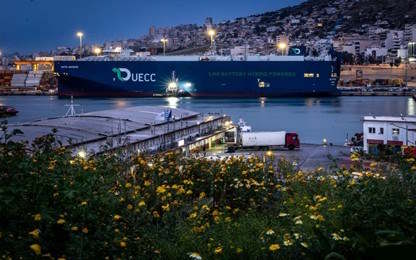
Image: UECC’s multi-fuel LNG battery hybrid PCTC ‘Auto Achieve’ is part of the Sail for Change programme (credit: UECC/George Giannakis)