
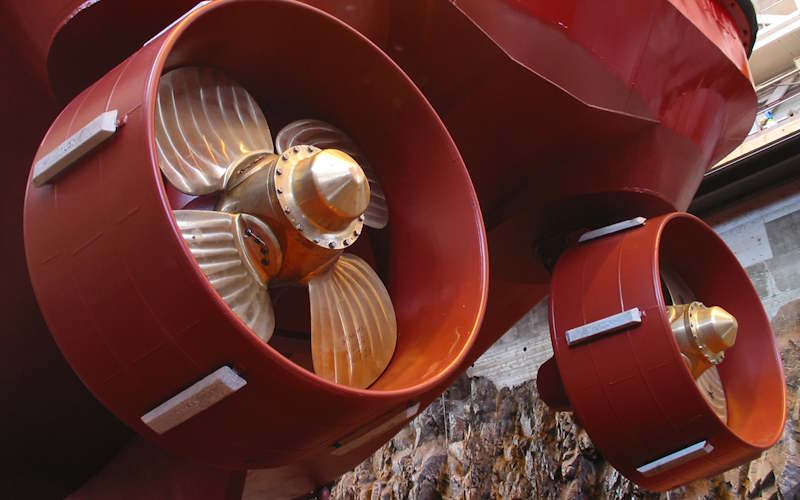
According to Swedish company Brunvoll, designing a ship is always a compromise between different parameters, with the aim of creating a vessel that can carry out its mission safely and efficiently.
For many vessel types, this often means fitting a larger propeller and nozzle to achieve the required bollard pull and station-keeping capability. This, however, comes at the expense of transit efficiency, where a smaller open propeller—or even a contra-rotating propeller—would have been preferable. This is where the Dragless Nozzle comes in.
‘Every percentage counts’ is the reason for developing the new nozzle profile. Brunvoll’s hydrodynamics took all known nozzle profiles, broke them down into parts, and studied them closely to understand what parameters could be tweaked in order to achieve the required behaviour and performance.
The outcome is the DL1 nozzle—also referred to as ‘Dragless’. The name reflects its design objective: to minimise the transition from net thrust to net drag at higher vessel speeds, a common limitation of conventional nozzle profiles. While traditional nozzles, such as the 19A, experience an efficiency drop at transit speeds, the DL1 maintains favourable hydrodynamic characteristics across a broader operating range.
A common characteristic of some configurations is a significant drop in efficiency at higher transit speeds. This is precisely where the DL1 nozzle is considered to deliver a marked improvement in performance compared to conventional designs.
Case studies conducted by Brunvoll highlight the DL1 nozzles properties for various ship types such as fishing vessels and offshore support ships. The latter case involves a vessel equipped with a conventional propulsion system comprising two azimuth thrusters. These vessels demand similar performance traits as fishing vessels but also have strict requirements for station keeping capabilities.
The 19A nozzle performs well under bollard pull conditions, but with the DL1 Brunvoll’s hydrodynamics team developed a design that is said to deliver 99.6% of the thrust produced by the 19A, along with improved overall efficiency. The speed-power curve for the offshore supply vessel compares the delivered power of the two different nozzle profiles as a function of vessel speed. For instance, at 13 knots, the DL1 nozzle requires 10.3% less energy to maintain the same speed as the 19A.
A nozzle also influences the cavitation characteristics of the propeller, which is another key performance indicator used in evaluating the different designs iterations that led to the DL1-nozzle. Some cavitation is expected with conventional propeller and nozzle designs. The key, however, is to avoid cavitation that may cause damage to the vessel and its equipment, such as erosion, reduced performance, or increased maintenance needs — as well as cavitation that can negatively affect crew health and comfort, by contributing to elevated levels of noise and vibration. While both 19A and DL1 nozzle designs show signs of cavitation near the propeller tips, the DL1 demonstrates a greater margin elsewhere, indicating improved hydrodynamic performance.
The key advantages of the DL1, according to Brunvoll, are:
- The DL1 nozzle reduces the sudden drop in efficiency as the thrust load coefficient approaches zero.
- The DL1 nozzle provides higher maximum propeller efficiency compared to the 19A nozzle.
- The 19A nozzle excels in bollard pull, but the DL1 matches 99.6% of its thrust while significantly improving transit efficiency.
- The DL1 nozzle offers a lower risk of cavitation compared to other nozzle profiles.
Image: Azimuth thrusters with 19A nozzles (source: Brunvoll)