
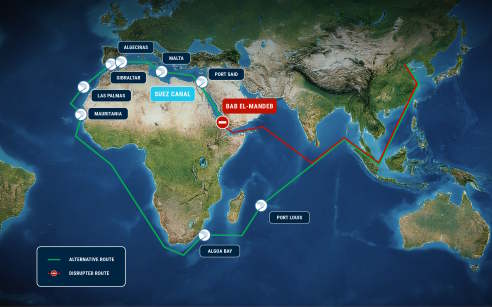
As Red Sea hostilities continue to force widespread maritime diversions around the Cape of Good Hope, leading bunker company Peninsula is warning of a ‘perfect storm’ for global tanker operators.
An unprecedented surge in tonne-mile demand is now intersecting with stringent Mediterranean emissions regulations, threatening to more than double operational costs and severely tighten bunker supply at alternative key ports. With the Bab el-Mandeb Strait increasingly bypassed, vessels are exiting the Red Sea via the Suez Canal and navigating westbound through the Mediterranean to reach Asia.
Peninsula notes that this detour could more than double the normal tonne-mile demand of a Bab el-Mandeb eastbound exit. For a typical Suezmax tanker, the diversion will require around 1,500t of additional fuel, at a cost of circa US$ 800,000 and an emissions cost of roughly 3,800t CO2e. Spot rates for Suezmax vessels – the largest tankers that can transit the Suez Canal fully laden – are already increasing, causing a scramble to cover the cargoes before the tonne-mile effect kicks in.
Kenny MacLean, Peninsula COO, said: “The industry could be dealing with a sudden, significant increase in fuel consumption. This is more complex than simply plotting a longer course – it will require a fundamental recalibration of voyage economics that will squeeze global bunker supply at a time when demand already outstrips supply.”
Beyond the raw cost of fuel, Peninsula is highlighting a critical regulatory blind spot for rerouted vessels: the Mediterranean Emissions Control Area (MedECA). Under these rules, vessels transiting the entire Mediterranean must burn fuel with a maximum sulphur content of 0.1%, rendering standard VLSFO non-compliant.
With European authorities increasingly deploying ‘sniffer drones’ to remotely analyse vessel emissions in real-time, operators must switch to compliant MGO or suitable biofuels before entering the region. Failure to secure compliant fuel risks severe fines and costly vessel detentions. The sudden shift in maritime traffic could redraw the global bunkering map. Peninsula expects significantly increased demand in alternative physical supply ports along the revised route, including Port Said, Malta, Gibraltar, Algeciras, Las Palmas, Algoa Bay, and Port Louis.
Richard Alvarez, Global Head of Sales, Peninsula, added: “Operators are navigating a regulatory and logistical minefield. Securing compliant fuel conveniently, in the right location, in a rising price environment is now the defining challenge of these deviated voyages. As supply tightens at alternative bunker hubs, the ability to rely on suppliers with a globally integrated supply network and deep access to multi-product cargos will prove critical to minimise disruption and avoid the costs of non-compliance.”
Image: Alternative tanker bunker locations (source: Peninsula)