
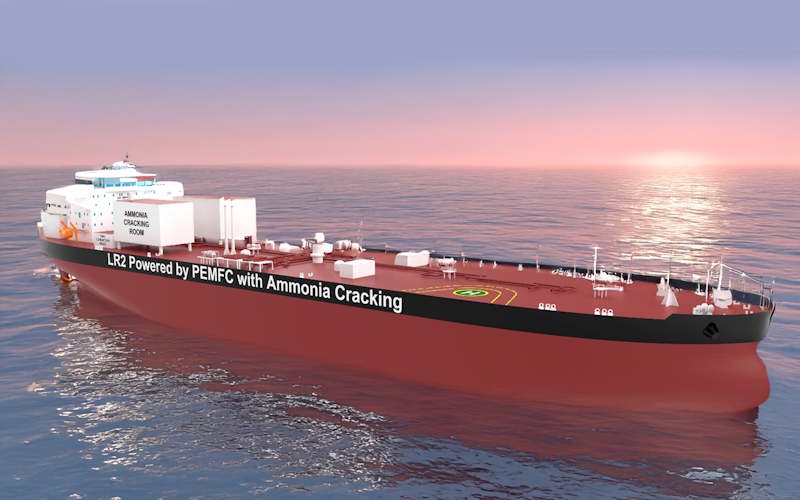
MISC Berhad (MISC) and Samsung Heavy Industries (SHI) have received Approval in Principle (AiP) from Bureau Veritas Marine & Offshore (BV) for a pioneering design of what is said to be the world’s first ammonia-fuelled LR2 tanker powered by Proton Exchange Membrane Fuel Cell (PEMFC) technology.
The AiP from BV confirms the technical feasibility of the concept as well as initial conformity to the applicable rules, industry codes, and standards. The AiP was awarded as part of a strategic Joint Development Project involving MISC, SHI, and BV. This initiative focuses on the design and development of a large-scale commercial vessel that integrates PEMFC technology developed by Vinssen and is integrated with an Ammonia Cracking System (ACS) engineered by Panasia. This design will enable full-scale power for vessel propulsion, cargo handling, and onboard energy needs, surpassing previous applications, which have been limited to small vessels or auxiliary loads.
The vessel is developed to meet stringent IMO regulations while delivering significant operational benefits. Its key advantages include:
- Zero direct emissions: eliminates direct CO₂ emissions, aligning with global decarbonisation goals.
- Regulatory compliance: future-proofs vessels against evolving environmental regulations and carbon taxation.
- Operational efficiency: offers alternative fuel utilisation and lower maintenance costs compared to traditional engines.
- Scalability: paves the way for broader adoption of ammonia-based fuel cell technology across the maritime sector.
Zahid Osman, President and Group CEO, MISC said, “We firmly believe that collaboration is the catalyst for maritime transformation and through this partnership, we are delivering progress by uniting industry leaders in realising a future where various new technologies being deployed to solve maritime’s greatest challenge, energy transition and decarbonisation. This AiP is the result of combining our strengths and challenging conventional boundaries to transform sustainability aspirations into tangible progress. Together with SHI and BV, we are advancing a solution that will set a new standard for sustainable shipping and inspire greater industry-wide adoption of innovative solutions that will help the maritime industry meet its net-zero ambitions.”
Haeki Jang, SHI CTO, added: “It is a great honour to be here today for this milestone. Our ammonia-fuelled LR2 tanker powered by fuel cell represents a true step forward — delivering zero emissions, meeting future regulations, improving operational efficiency, and offering scalability for wider adoption. This innovation shows Samsung Heavy Industries’ strong commitment to sustainable growth and advanced technology. I would also like to thank the classification society and MISC for their valuable support and close cooperation.”
Matthieu de Tugny, BV EVP Industrials and Commodities, said: “This Approval in Principle is not only a technological milestone but also the power of strong partnerships. Bureau Veritas is proud to support MISC and Samsung Heavy Industries in advancing ammonia-fuelled PEM fuel cell technology — a breakthrough that combines innovation, safety, and sustainability. We remain fully committed to supporting the development of viable, scalable, and safe alternative fuel solutions that will shape the future of sustainable shipping.”
In the Joint Development Project, MISC serves as the ship owner and operator, leading vessel operations, commercial feasibility studies, and market adoption strategies. SHI contributes shipbuilding expertise, overseeing vessel design, system integration, and engineering development. As the classification society, BV is responsible for ensuring regulatory compliance, conducting risk assessments, and granting the AiP, if it complies with the applicable BV Rules for classification. This provides independent validation of the project’s technical feasibility and safety.
Image: The world’s first ammonia-fuelled LR2 tanker powered by PEMFC technology (source: Bureau Veritas)