
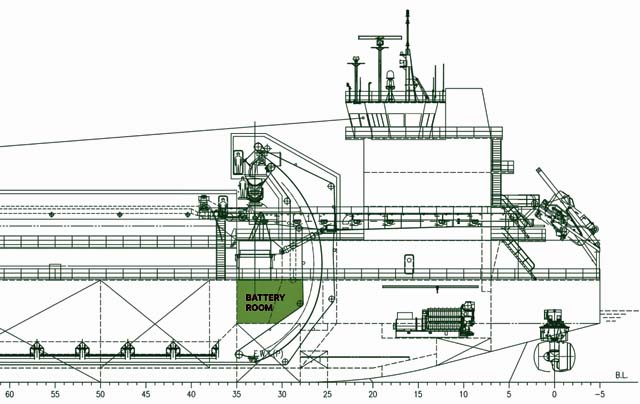
Canadian shipping company CSL has formed a 20-year strategic partnership with South Australian company Adelaide Brighton Cement (Adbri) to build and operate a fully electric battery-capable self-unloading vessel.
The custom-designed ship, believed to be the first of its kind, will replace Adbri’s Accolade II and will support the company’s limestone operations in South Australia with a focus on enhanced efficiency and environmental responsibility. The ship will carry up to 2.7m tonnes of limestone per year, which represents a 35% increase over the existing vessel’s carrying capacity.
Louis Martel, CSL President and CEO, said: “Developed in line with CSL and Adbri’s shared decarbonisation vision, this groundbreaking vessel will initially run on a hybrid diesel and battery system, replacing 25% of diesel with electric power and lowering Scope 1 emissions by 40% compared to Accolade II. By 2031, we aim to run the ship entirely on electric power, further reducing Scope 1 emissions to less than 10%.”
The design of the 11,000 dwt self-loading and self-discharging bulk carrier has been optimised to provide a fully integrated limestone supply chain for Adbri. The hybrid diesel-electric propulsion system combined with what is considered one of the most advanced battery installations on a bulk carrier will provide a pathway to decarbonise shipping operations. Approximately 50% of the vessel’s energy requirements will be provided by a combination of shore power and battery energy storage, with plans to install sufficient batteries in the future to allow 100% electric operations.
Adbri CEO Mark Irwin said: “Adbri is excited to have one of the world’s first 100% battery electric capable cargo vessels as our limestone carrier. The new vessel, owned and operated by CSL, will support Adbri to increase cement volumes at Birkenhead, while also supporting the production of lower carbon products such as EvoCem that uses limestone as a clinker substitute.”
Construction of the new vessel will begin in 2024 and delivery is expected in early 2026.