
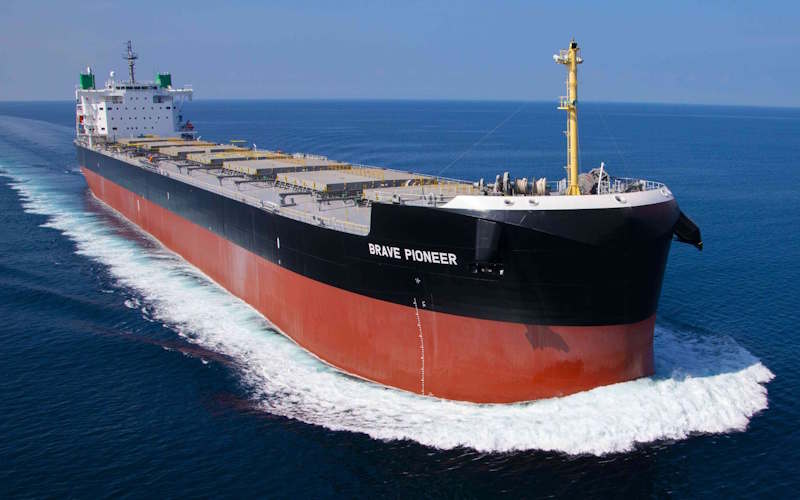
Cargill has begun the maiden voyage of ‘Brave Pioneer’, delivered from Tsuneishi Shipbuilding’s Cebu yard in the Philippines, first of five green methanol dual-fuel dry bulk vessels chartered by the company.
The deployment of the Brave Pioneer is seen as an important milestone in Cargill’s broader decarbonisation efforts – one focused on innovation, testing and learning as the company works with customers and partners to refine future-ready solutions.
Chartered from Mitsui & Co, Brave Pioneer is equipped to operate on both conventional marine fuels and green methanol, a lower-carbon alternative. The estimated CO2 saving of using green methanol compared to conventional fuel is up to 70%.
The ship will bunker green methanol in Singapore, then proceed to Western Australia before sailing onward to Europe. Through Brave Pioneer’s maiden voyage, Cargill will conduct a series of operational trials designed to evaluate green methanol bunkering readiness, understand how environmental attributes can be traced and verified through carbon accounting systems, and assess market appetite for low-carbon freight services.
Jan Dieleman, President, Cargill Ocean Transportation business, said: “Decarbonising global shipping requires a mix of technologies and the willingness to take bold steps before the entire ecosystem is ready. Technologies like green methanol or wind-assisted propulsion come with uncertainty. But as an industry leader, we have a responsibility to test these innovations on the water, share what we learn, and help shape the systems and standards that will enable wider adoption.”
The launch of Brave Pioneer paves the way for the four additional vessels that will join Cargill’s fleet over the coming years. The addition of these vessels will strengthen Cargill’s multi-solution decarbonisation approach, which includes wind-assisted propulsion, voyage optimisation technologies, energy-efficiency retrofits and exploration of alternative fuels such as biofuels and ethanol.
Each represents another step in the company’s broader efforts to embed sustainability into global ocean supply chains and support customers looking for practical, lower-carbon freight options.
Dieleman added: “We know the road to low carbon shipping will require a mix of solutions and green methanol is one part of that portfolio. Our new fleet is about optionality and adaptability. These vessels are engineered to perform at a best-in-class level on conventional fuel today, while allowing us to switch to greener fuels as availability improves. It’s a practical way to future-proof ocean transport.”
As one of the largest charterers of dry bulk freight, Cargill’s actions are considered to send a signal to the market and serve as an open invitation for others in the maritime sector to join in advancing the transition to sustainable shipping. The initiative supports Cargill’s broader effort to reduce supply chain emissions and invest and test practical innovations that advance progress toward a more sustainable global food system. Green methanol-enabled vessels—paired with the eventual expansion of renewable fuel supply—are expected by the company to play a meaningful role in reducing maritime emissions over the coming decade.
Image: Methanol Dual-Fuelled Kamsarmax Bulk Carrier ‘Brave Pioneer’ (source: Tsuneishi Shipbuilding)