
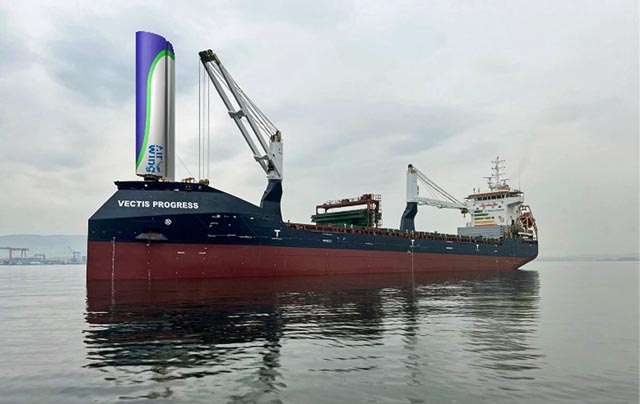
GT Green Technologies, in collaboration with Carisbrooke Shipping and The University of Bristol, has been awarded a £3.7m UK Government grant to install a 20m AirWing unit on a Carisbrooke Shipping general cargo vessel.
The project will be funded through the Clean Maritime Demonstration Competition Round 4 (CMDC4). The AirWing wind propulsion system will propel the vessel on its UK-Canada-UK route, offering expected fuel and carbon emission savings of some 8.3%, resulting in annual cost savings exceeding £139,000. Over its 25-year lifespan, the 20m AirWing is considered to have the potential to reduce CO2 emissions by an estimated 14,250t.
AirWing employs airflow manipulation technology designed to maximise thrust output while maintaining a compact and lightweight profile. The patent-pending innovation is designed to address the need for sustainable shipping solutions, particularly on general cargo ships with limited deck space.
Carisbrooke Shipping, overseeing the technical management of a global fleet of 27 vessels, is strategically positioned as the first to integrate this technology. This move by Carisbrooke is said to set an example to other industry players considering similar advancements to enhance operational sustainability.
Capt Simon Merritt, Fleet Manager Carisbrooke Shipping, said: “We’ve been discussing various technologies with GT Green for the last two years and are excited to be prototyping their AirWing concept in 2024. Using AirWing technology will reduce operating costs by lowering fuel consumption and emissions. It will improve the vessel’s green credentials and lower the tax burden for the ship’s operators. We will be installing the AirWing on one of our UK-registered vessels, and all the design work as well as construction will be carried out in the UK.”
Tobias Laux, Research Associate, University of Bristol, said: “We are very excited to be part of the AirWing consortium and to contribute our expertise in composite structures testing and modelling to the development of innovative wind propulsion technology. We believe that wind propulsion will play an important role in future sustainable shipping and that cross-disciplinary research in fluid dynamics, structures, and ship science will be necessary to harness its full potential.”
GT Green Technologies has conducted feasibility studies for global shipowners and received interest in future orders. With 20,000 ships globally suitable for wind propulsion (and only around 35 installations to date), the market is vast, and GT Green Technologies believes it is positioned for rapid commercial deployment and scale-up.
The project is part of the Clean Maritime Demonstration Competition Round 4 (CMDC4), funded by the UK Department for Transport (DfT) and delivered by Innovate UK. CMDC4 is part of the Department’s UK Shipping Office for Reducing Emissions (UK SHORE) program, a £206m initiative focused on developing the technology necessary to decarbonise the UK domestic maritime sector.
Image: 20m AirWing unit on a Carisbrooke Shipping general cargo vessel (source: GT Green/IWSA)