
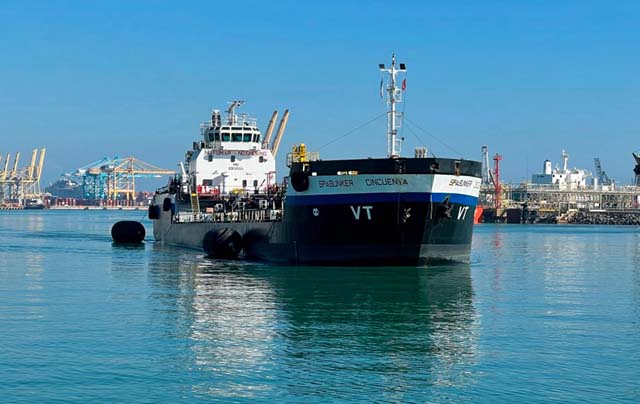
Spanish oil company Cepsa has undertaken the largest supply of second-generation biofuels to date at the Port of Barcelona, bunkering a 350m container vessel operated by Hapag-Lloyd in the Mediterranean.
Cepsa says this marks its inaugural venture in Barcelona and positions the Port of Barcelona as a key player in the decarbonisation of maritime transportation. The supplied biodiesel contains a 24% sustainable component, which will prevent the emission of 2,860t of CO2, This biofuel has been produced from used cooking oils. Currently, Cepsa can supply these sustainable fuels by barge in the Port of Barcelona and the area of the Strait of Gibraltar, and by tanker in all the ports in which it operates.
Samir Fernández, Cepsa director of Marine Fuel Solutions said: “Second-generation biofuels can be used in ships without the need for modifications to their engines, and they have a high potential for reducing CO2 emissions compared to conventional fossil fuels, achieving a reduction of up to 90%, which makes them an ideal immediate solution. That’s why we want to make them available in all the ports in which we operate and lead their production in this decade to help our customers meet their own decarbonisation challenges.”
The use of biofuels enables shipping companies to stay ahead of the objectives of the EU and IMO. Cepsa is committed to second-generation biofuels as a catalyst for advancing the decarbonisation of maritime transportation. It complements other recent supply efforts, including this summer’s supplies for 84 ferry voyages by Naviera Armas Trasmediterránea at the Port of Algeciras, as well as the recent supply operation in Algeciras using the hybrid supply vessel Bahía Levante. The company had previously conducted successful tests of these sustainable fuels within its own fleet, demonstrating optimal engine performance and efficiency.
In addition to biofuels, Cepsa products include LNG, and in the future synthetic marine fuels, such as green ammonia or methanol, produced within the Andalusian Green Hydrogen Valley, the largest green hydrogen project in Europe.