
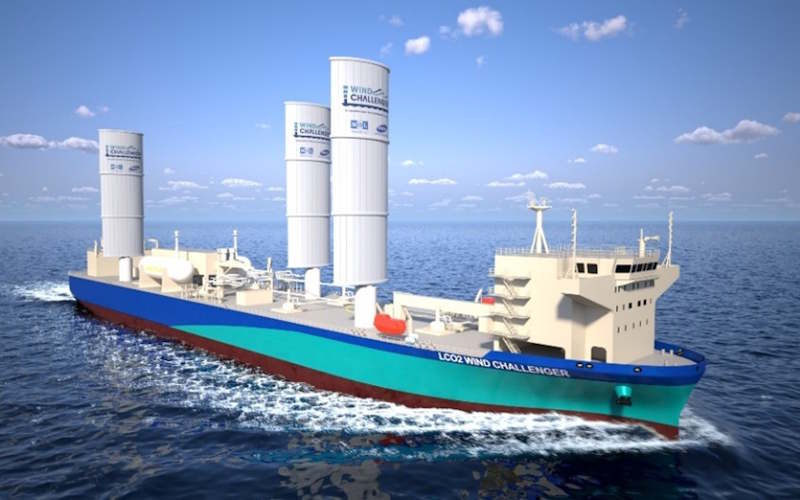
A liquified CO₂ (LCO2) carrier concept design jointly developed by Mitsui OSK Lines (MOL) and Samsung Heavy Industries (SHI) with MOL’s Wind Challenger hard sail wind propulsion system has been awarded approval in principle (AiP) by ClassNK.
The AiP confirms the feasibility of the ship’s design from the perspective of applicable rules and safety requirements. As a solution for responding to environmental regulations and reducing fuel costs, implementation of wind-assisted propulsion systems (WAPS) has been steadily progressing. When such systems are installed on board ships, they are expected to be effective in reducing CO₂ and other emissions by taking advantage of wind power. To support the safe implementation of these technologies, ClassNK has published its Guidelines for Wind-Assisted Propulsion Systems for Ships as a standard for WAPS and ships equipped with these systems.
ClassNK carried out a review of the conceptual design of the ship based on its Rules and Guidance for the Survey and Construction of Steel Ships, and Guidelines for Wind-Assisted Propulsion Systems for Ships (Edition 2.2). In addition, ClassNK participated in a risk assessment through Hazid from a regulatory and technical perspective to examine the combined risks arising from the ship’s unique design elements —such as the fore accommodation, liquefied CO₂ cargo, and multiple units of the Wind Challenger— and validated the results of the assessment. Upon confirming the results and that the prescribed requirements had been met, ClassNK issued the AiP.
ClassNK says it will continually strive to contribute to advanced decarbonisation initiatives through safety-based and other assessments.
Image: Liquefied CO₂ carrier equipped with Wind Challenger (credit: Mitsui OSK Lines)