
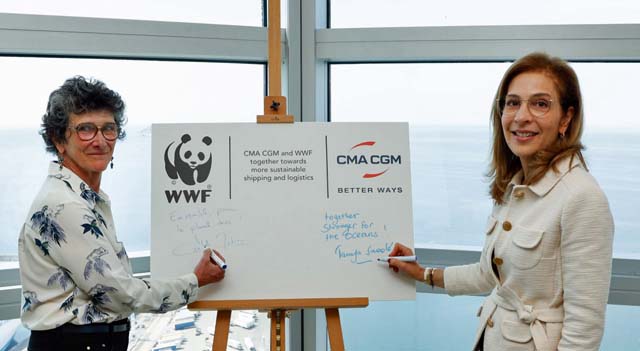
French shipping company CMA CGM Group has entered a partnership with WWF France to decarbonize shipping and logistics, strengthen the fight against illicit trafficking in protected species and preserve marine ecosystems.
The collaboration is in line with CMA CGM’s commitment to achieve Net Zero Carbon by 2050 and various other initiatives undertaken by CMA CGM to reduce its environmental footprint and fight against ocean pollution.
The two-year partnership between CMA CGM and WWF France includes three major areas of collaboration:
- Decarbonisation of maritime transport and logistics, to identify the most sustainable ways of reducing greenhouse gas emissions so as to implement an ambitious decarbonisation trajectory in line with the objective of limiting global warming to 1.5°C, in particular through the global Science Based Target initiative.
- Fight illicit trafficking in protected species, by supporting the Group in its efforts to strengthen its vigilance against this illegal activity and by contributing to the development of internal tools and procedures by 2023 to address it. The partnership also aims, through the Group’s commitment and experience, to raise awareness among its stakeholders and its sector about this issue and the existing solutions.
- Preservation and conservation of marine ecosystems, with CMA CGM financing four sponsorship projects for the preservation and conservation of marine ecosystems in the Mediterranean, South Africa, the Philippines, and the Arctic.
The preservation of the environment and biodiversity is one of the pillars of the strategic vision adopted by the CMA CGM Group under the leadership of its Chairman and CEO, Rodolphe Saadé. The partnership with WWF France echoes actions taken by the Group to tackle global warming and its effects on biodiversity, such as the decision not to use the ‘Northern Sea Route’ in order to preserve the fragile ecosystems of the Arctic, to strengthen the detection and protection of cetaceans or to stop transporting plastic waste by sea in order to prevent it from being exported to countries where its treatment or recovery cannot be guaranteed.