
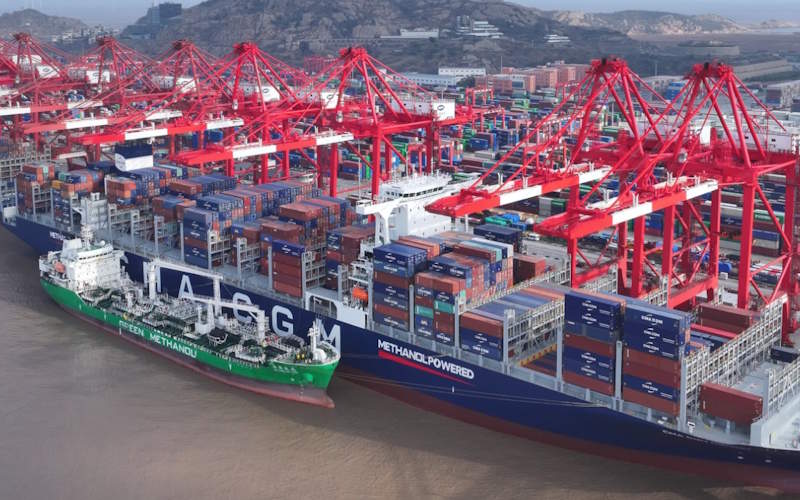
The CMA CGM Group and SIPG Energy recently successfully completed the first bio-methanol bunkering of the ‘CMA CGM Osmium’ at Yangshan Port’s Shengdong Terminal.
This newly delivered 13,000 TEU bio-methanol dual‑fuel containership will soon operate on the M2X service connecting Asia with Mexico.
Farid Trad, CMA CGM Group VP Energy Transition, said: “The bio-methanol bunkering of the CMA CGM Osmium is more than a technical success, it marks a defining moment in our decarbonisation journey. Together with SIPG Energy, we are demonstrating that cleaner, low‑carbon shipping is no longer an aspiration but a reality. This milestone strengthens our resolve to work closely with our partners to accelerate shipping decarbonisation and propel our industry toward a more sustainable future.”
Luo Wenbin, SIPG Energy MD, added: “The completion of China’s largest single bio-methanol bunkering operation with CMA CGM marks a significant leap in Shanghai Port’s bio-methanol bunkering capacity. SIPG Energy will continue to enhance its integrated capabilities in bio-methanol resource coordination, storage and transportation support, and bunkering services, deepen cooperation with leading shipping enterprises, and help build Shanghai Port into a global sustainable energy bunkering hub.”
A total of 3,643t of bio-methanol from suppliers including Shanghai Electric Group in their production base in Taonan, Jilin province was bunkered, the largest single bio-methanol bunkering volume ever completed at a Chinese port. For CMA CGM, this operation marks a milestone, representing both the Group’s first bio-methanol bunkering, further cementing Shanghai’s importance within the Group’s worldwide low‑carbon development roadmap. Bio-methanol is a low-carbon fuel produced from renewable or waste-based biomass, offering lifecycle greenhouse gas emission reductions of more than 65% compared with conventional marine fuels.
As part of its commitment to achieving Net Zero Carbon by 2050, the CMA CGM Group is deploying what it considers the best available solutions to reduce the environmental footprint of global maritime transport and logistics. In line with this ambition, the Group is preparing to operate around 200 dual‑fuel container vessels by 2031, all capable of running on low‑carbon energy (bio- and e-LNG as well as bio- and e-methanol).
CMA CGM’s long-standing collaboration with its partners SIPG Energy and Shanghai Electric Group include a long‑term LNG bunkering partnership with SIPG and the framework agreement on long-term bio-methanol supply signed by CMA CGM. This established partnership has played a pivotal role in establishing the foundation for this latest milestone in China. The successful bio-methanol bunkering of CMA CGM Osmium is said to further demonstrate the Group’s determination to accelerate the adoption of sustainable alternative fuels across its global network, as well as reinforcing Shanghai’s emergence as an international hub for sustainable marine fuels, supporting China’s national objectives for low‑carbon, sustainable shipping.
Image: Bio-methanol bunkering for ‘CMA CGM Osmium’ (source: CMA CGM Group)