
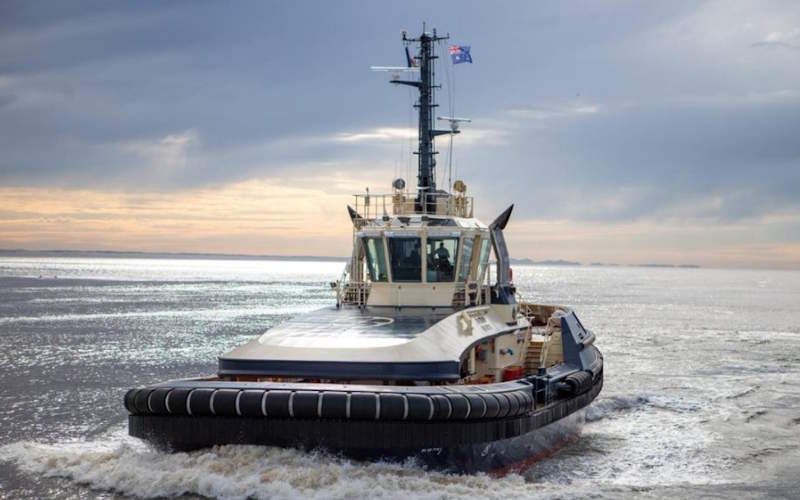
Svitzer and Cochin Shipyard Limited (CSL), India’s largest public sector shipyard, have signed a shipbuilding agreement for four 26m electric TRAnsverse 2600E tugs to be constructed in India for Svitzer’s global fleet renewal and growth plans.
The agreement confirms a Letter of Intent signed in 2025 and marks the move from intent to a contracted new build agreement.
Under the agreement, CSL will build a minimum of four battery-electric TRAnsverse 2600E tugs for Svitzer, with an option for up to four additional vessels. The tugs will be constructed at CSL’s facilities in Cochin to Svitzer’s specifications to serve as global fleet renewal and advancement in operations worldwide. The vessels complement a wider newbuilding program of the advanced new TRAnsverse tug design, cementing Svitzer’s confidence in the vessel’s capabilities while also opening opportunities for future deployment in Indian ports and terminals.
The deal brings together Svitzer’s experience in advanced and sustainable towage with CSL’s shipbuilding capabilities. It supports India’s ambition to become a global maritime manufacturing and skills hub.
Svitzer’s TRAnsverse 2600 series tugs designed to operate in complex and close-quarter operating contexts, with all ship types and sizes in challenging weather and tidal conditions. The 2600E vessels will feature battery-electric propulsion and offer zero direct emissions during harbour operations when charged from green power sources. The patented double-ended hull design and in-line propulsion with omni-directional thrust is said to expand the dynamic operating envelope in towage up to 50%.
Kasper Nilaus, CEO Svitzer, said: “This contract with Cochin Shipyard for our next series of electric TRAnsverse tugs reflects our commitment to Make in India and to support port and terminal operations in their green transition and decarbonisation objectives. India has strong shipbuilding capabilities; a highly skilled workforce and we are aligned with their future maritime ambitions. Through this collaboration with CSL, we are not only investing in a series of advanced tugs for our own operations – we are also helping to build capacity for world-class, low- and zero-emission tug construction in India – signalling our trust in India’s existing capability and maritime vision. We look forward to working closely with the CSL team to deliver these vessels and, in doing so, to support the goals of Maritime India Vision 2030 and Maritime Amrit Kaal Vision 2047 in a very practical way.”
Madhu S Nair, CSL, added: “We look forward to delivering the next generation of tug, the TRAnsverse 2600e, drawing on CSL’s skilled workforce and our track record in complex, high-spec vessels. This agreement represents a natural expansion of our capabilities into advanced tug design and the industrialisation of battery-electric and future-fuel-ready technologies in India.
The programme will deepen our expertise in electric propulsion, high-precision manoeuvring systems and integrated digital solutions for ports and terminals, while creating opportunities for our engineers, designers and local supply chain. As a Government of India company, we remain committed to Make in India and to the decarbonisation of maritime transport. Together with Svitzer, our goal is to deliver a world class asset with significant decarbonisation credentials for ports in India and around the world.”
The first four vessels under the agreement are expected to enter construction in the third quarter of 2026, with the first delivery targeted no earlier than late 2027 / early 2028, subject to detailed design, yard scheduling and regulatory approvals. Further vessels may follow in line with Svitzer’s fleet renewal plans and customer demand.
Image: Four of Svitzer’s 2600E tugs will be built in India (source: Cochin Shipyard)