
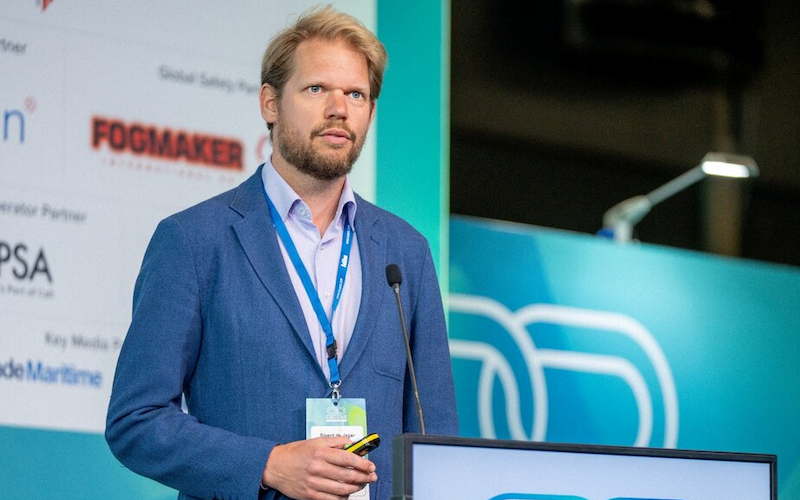
Maritime emissions tracking company PortXchange has warned that shipping is heading for a costly patchwork of national and regional climate rules unless IMO member states adopt the Net-Zero framework, after the UN climate summit in Antalya collapsed without a deal.
COP31 closed without a final text, the first time since 2009 the annual summit has failed to agree, after Saudi Arabia and other oil producers forced fossil fuel language out of the draft. Eight days later, IMO member states meet for MEPC 85, with the resumed extraordinary session on 4 December hoped to be able to decide the framework’s fate. The last attempt, in October 2025, was postponed by 57 votes to 49 after the US threatened tariffs, visa restrictions and port fees against countries backing the framework.
Sjoerd de Jager, MD and Co-Founder, PortXchange, said: “COP and the IMO are watching the same film. A handful of countries whose economies run on oil and gas are blocking what most of the world has already said it wants. At COP they deleted the words. At the IMO, they went further and threatened the trade of anyone who voted the other way.”
The delay is already costing the transition. The UCL Energy Institute and Getting to Zero Coalition’s Climate action in shipping 2026 report calls last year’s failure to adopt the framework “the single most transition-regressive event” in its five years of tracking. The share of tonnage on order that can run on scalable zero-emission fuels fell from 9.5% to 5.7%, while conventional-only ships rose from 54% to 61% of the orderbook. Even if it is adopted next week, the framework cannot take effect before 2029.
The Global Maritime Forum counts 84 active green shipping corridors worldwide, yet only four have reached the stage where vessels, infrastructure or fuel plants are actually being built or operated. The cost gap between conventional and low-carbon fuels is the main brake.
de Jager added: “Nobody on the water is short of ambition. Owners are electrifying barges, trailing hydrogen-derived fuels and asking the IMO, again and again, for clear rules. What kills most corridors between pilot and operation is the operating cost: someone has to pay the premium on green fuel and electricity. The net-zero framework is the only measure on the table built to close that gap worldwide and a few governments are holding it back while the rest of the industry pays for it.”
Without a global deal, countries and regions will keep writing their own rules. The EU already applies its ETS and FuelEU Maritime to ships, and the Netherlands and Spain have added national obligations on marine fuel suppliers. Since July 2026, the UK has run a separate carbon price, the UK ETS, on domestic voyages and on emissions while ships of 5,000gt and above are in UK ports. Every extra layer adds compliance work for operators trading across borders and pushes cost and cargo from one market to the next. The UK Chamber of Shipping has asked for any extension of the UK ETS to international voyages to wait until the IMO completes its net-zero framework negotiations, so the December 4 decision will also shape how far that patchwork spreads in UK waters.
de Jager continued: “If member states walk away again on 4 December, the IMO’s authority as shipping’s global regulator takes a hit it may not recover from. What replaces it is a patchwork of regional carbon prices and fuel rules and ships cross every border, so this industry will pay for that fragmentation more than any other.”
PortXchange is urging ports and operators to act whatever the vote. Synchronising arrivals so ships slow down at sea instead of waiting at anchor cuts fuel burn straight away. At the Port of Algeciras, real-time port call coordination through PortXchange’s Synchronizer cut idle time per vessel arrival and departure by nearly 40% and avoided an average of 32.9 tonnes of CO2 per port call. Measuring emissions call by call with EmissionInsider then shows where shore power and other investments will make the biggest difference.
de Jager concluded by setting a challenge for the industry: “Member states have one job on 4 December: adopt the framework as it stands. Another year of delay is a decision too and the industry will remember who took it. Stop waiting for London. Every port and every operator can cut emissions this year with data and tools that already exist. If governments won’t lead, the industry has to and the companies that move now will be ready for whatever rules finally arrive.”
Image: PortXChange MD Sjoerd de Jager (source: PortXchange)