
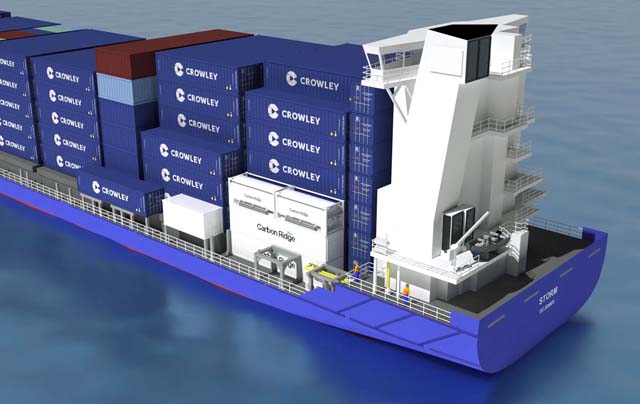
Shipping company Crowley is partnering with US company Carbon Ridge, which develops modular onboard carbon capture and storage (OCCS) systems, with support from the US Maritime Administration (MARAD) Maritime Environmental and Technical Assistance (META) program, in a pilot project to reduce emissions impacts using Crowley’s ‘Storm’ container ship.
Using Carbon Ridge’s patent-pending, second generation carbon capture technology, the companies and MARAD have executed a cooperative agreement for the pilot programme to operate, measure and optimise the technology’s effectiveness in actual maritime environments at port and ultimately at sea. The collaboration includes the engineering, manufacturing and integration of a small capacity version of Carbon Ridge’s full-scale carbon capture system.
Chase Dwyer, CEO, Carbon Ridge, said: “The advancement of the pilot project represents a milestone in the emerging technology for carbon capture. With its potential for significant emissions reductions through retrofitting or during new building, ship owners and operators have the opportunity to future-proof their vessels for incoming regulations, as well as reach internal goals for decarbonisation and reduced emissions impacts.”
Crowley’s engineering services group, which provides vessel design and engineering, project management and waterfront engineering by leveraging its research and development team for internal and external customers, is leading the integration of the pilot system on the Storm, which serves the US and Caribbean Basin. The carbon capture system will be housed in two 40ft container units on the vessel’s main deck and have an additional 20ft ISO-certified tank for storing the captured liquid CO2. The pilot project is expected to capture 1t/day from the vessel’s main engine.
Brett Bennett, SVP and GM Crowley Logistics, said: “We are excited to help spearhead the maritime industry’s journey to cleaner operations at sea and in our communities. This is a strong step forward to understanding and achieving our commitment to reaching net-zero emissions as part of our sustainability strategy.”
Daniel Yuska, director MARAD Office of Environment and Innovation, said: “MARAD is pleased to work with industry partners through META to demonstrate innovative technology applications that may lead to greater greenhouse gas emission reductions in the maritime sector.” Installation of the pilot unit on the vessel is expected in 2024 after completing onshore testing.