
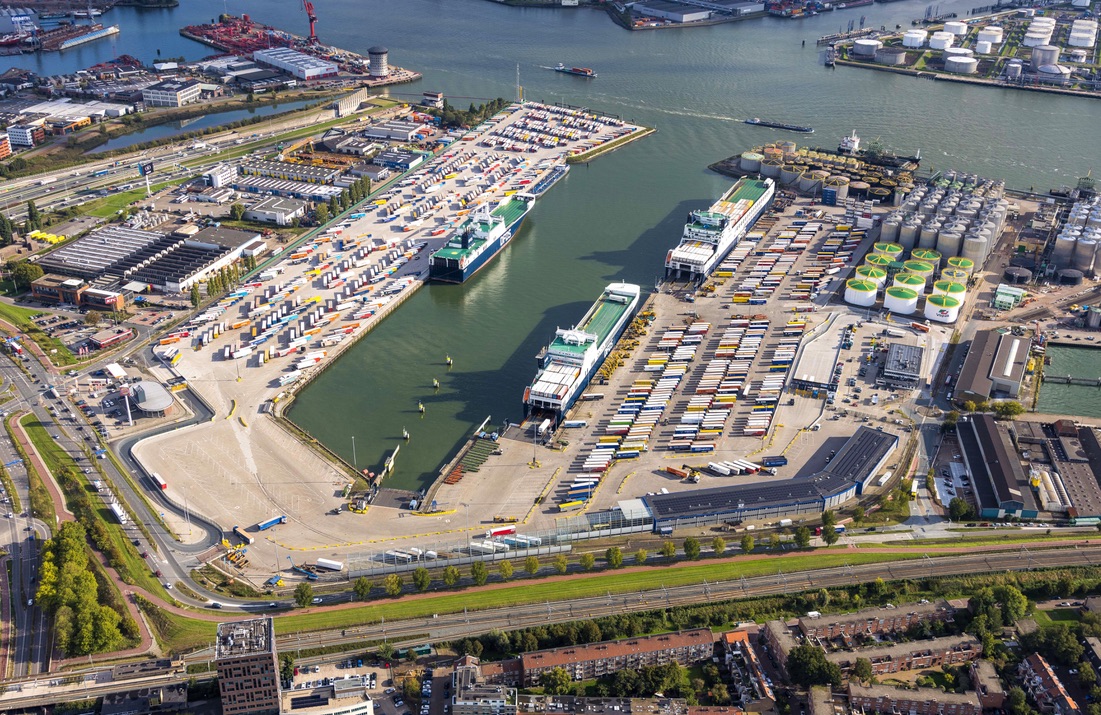
Rotterdam Shore Power, a joint venture of Eneco and the Port of Rotterdam Authority, is to supply shore power from Rotterdam for the DFDS terminal in Vlaardingen.
For now, Jinling ro-ro vessels for scheduled service to and from Immingham will use the shore power installation. The installation will be constructed by Actemium and has been partially made financially possible by subsidies from the central government and the province of South Holland.
The use of shore power for the berth for the Jinling roll-on-roll-off vessels is in line with the sustainable ambitions of DFDS aimed at reducing NOx and SOx emissions. The other two berths will be considered for shore power at a later stage. The shore power facility consists of a converted 40ft container containing electrical equipment that makes electricity from the public power grid suitable for use onboard the vessels. A cable management system will physically bring the electricity from the wharf to the ship with a cable and a plug. A remote control will enable the operation of the crane on the quay from the ship, so that the cable can be taken on board and then connected.
The shore power installation has a capacity of 1.8 MW and is expected to provide 3.5 GWh per year of electricity. The estimated CO2 reduction resulting from the investment is approximately 2,100t on an annual basis. In addition, shore power contributes to air quality by reducing particulate matter and nitrogen emissions and reduces noise pollution.
The Rotterdam Port Authority and Eneco want to stimulate the use of shore-based power in the port of Rotterdam and have set up subsidiary Rotterdam Shore Power to this end. In early 2022, the commissioning of Europe’s largest shore power installation was announced: the installation for Heerema Marine Contractors’ offshore vessels on Landtong Rozenburg. Rotterdam Shore Power is currently working on the construction of a second installation at Boskalis in the Waalhaven.
Shore power is considered a crucial pillar of the sustainability strategy for the Rotterdam port cluster. At least 90% of the offshore, ferries, cruise and ro-ro vessels and container ships in Rotterdam must use shore power by 2030. This will save emissions of about 200,000t of CO2 and 2,500t of nitrogen. This contributes towards an increasingly clean and future-proof port. Realisation of shore power fits in with Eneco’s One Planet Plan to be climate neutral by 2035, not only in its own activities, but also in the energy Eneco supplies to its customers.
The shore power project contributes to DFDS’ commitment to achieve net-zero CO2-emissions by 2050. One way to achieve this green transition is to invest significantly in sustainable solutions, including the target of 45% CO2 reduction within DFDS’ Ferry business.