Classification society DNV has validated wind-assisted propulsion company Norsepower’s new E-Cal calculation methodology, which calculates the effective power of Norsepower’s Rotor Sail (NPRS).
This helps ensure the vessel’s compliance with the latest IMO regulations, reducing the business risk for the shipyards, shipping companies, and ship owners. The result of NPRS propulsion power for the EEDI and EEXI calculations can be defined by the validated calculation method without ship-specific full-scale tests.
The regulations introduced by the IMO in 2021 (MEPC.1/Circ.896) mandate that the calculated performance of wind-assisted propulsion systems must consider aerodynamic interactions from the ship itself and the other rotor sails. Until now, this type of calculation could only be attained using demanding and costly processes such as model scale tests, computational fluid dynamics (CFD) simulations or full-scale tests. To address this, Norsepower developed an innovative method that combines CFD simulations, previously measured full-scale measurement results, and semi-empirical methods for the sail/sail interaction. This method has been validated against full-scale measurements in vessels already using NPRS. The method eliminates the need for complex physical measuring methods and simplifies the calculation validation process.
Jan Wienke, Principal Engineer DNV, said: “We are proud to have been chosen as the classification partner to review and validate Norsepower’s E-Cal Method against the MEPC guidance. DNV has been working on Wind Assisted Propulsion systems for several years now and we are always looking to help build confidence in these systems as the industry looks to tackle the decarbonisation challenge. This is the first review of this type DNV has performed, and we look forward to continuing to work with Norsepower.”
Fabian Kock, DNV Head of Section of Environmental Technology Air added: “Gains in energy efficiency are an essential part of the maritime industry’s energy transition. They can not only enhance a vessel’s sustainability, but enable the use of new fuels, and prolong compliance as regulations tighten. But for innovations to gain widespread acceptance, they need to proceed on a basis of trust. Which is why we were very pleased to work with Norsepower on this validation.”
The main benefits of the new method are:
- Simplified and reliable EEDI/EEXI calculations.
- Direct translation into compliance with FuelEU Maritime regulation regarding wind propulsion reward factor.
- Quicker first estimations of the EEDI impact of installing Norsepower rotor sails to make more informed decisions.
Heikki Pöntynen, CEO Norsepower, said: “We are proud to introduce this new technology with support from DNV as it’s another step forward in making energy efficiency calculations quicker, easier and more accurate. Obtaining the seal of approval from such a reputed classification society confirms that we are on the right track. The Norsepower E-Cal Method sets a new standard for the maritime industry and reinforces our commitment to driving sustainability and innovation.”
The collaboration between Norsepower and DNV is considered to mark a significant milestone in the advancement of wind propulsion technology, providing shipowners with a reliable and efficient solution for reducing emissions and achieving regulatory compliance.
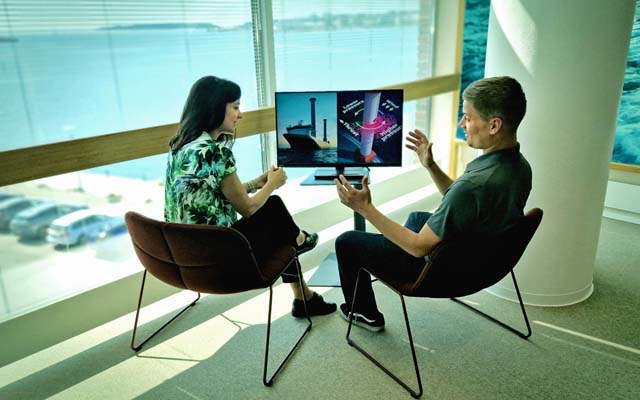
Image: Irene Perez Molina, Marketing and Communications Manager, Norsepower, and Severi Sarsila, Sales Engineer, Team Leader Norsepower (source: Norsepower)