
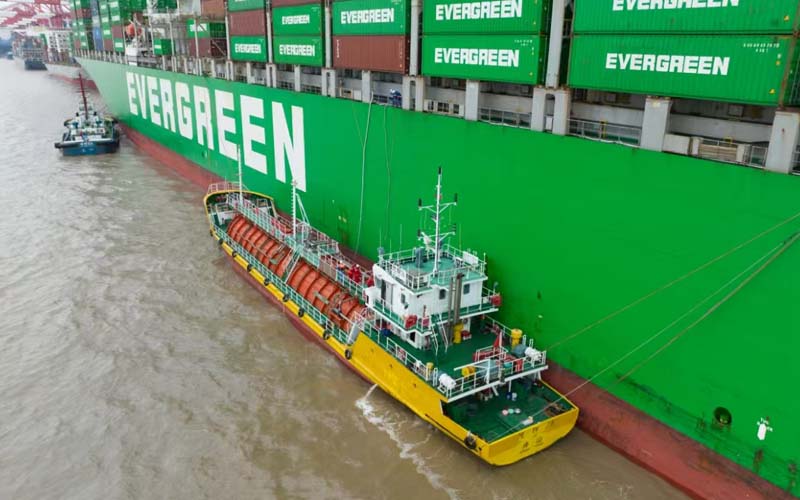
What is believed to be the world’s first ship-to-ship liquified carbon dioxide (LCO₂) transfer has been successfully completed at the Yangshan Deep-Water Port in Hangzhou Bay, Shanghai.
The project was led by Shanghai Qiyao Environmental Technology (SMDERI-QET), a subsidiary of Shanghai Marine Diesel Engine Research Institute (SMDERI), a unit of the China State Shipbuilding Company (CSSC). The project was supported by the Shanghai Port Group Energy Co and the Shanghai Port Group Logistics Co.
The transfer is said to mark a significant milestone for an industry under growing pressure to comply with increasingly strict local, regional and international regulations on emissions from ships. By completing the industry’s first ‘end to end’ solution, which includes onboard carbon capture, liquefaction, storage, and ship-to-ship offloading to a carbon utilisation facility, the project gives China a leading position in maritime decarbonisation.
Developed by SMDERI-QET, the onboard carbon capture and storage (OCCS) system achieved a comprehensive CO2 capture rate of over 80% with a liquid CO2 purity of 99.9%. And since the delivery of the first full-process OCCS in early 2024, SMDERI-QET says it has successfully completed multiple end-to-end LCO₂ offloading projects, from capture to recycling, which have allowed participating owners to achieve higher CII ratings, considered a first for OCCS technology.
However, until now, wider uptake of OCCS technology has been slowed by inadequate port infrastructure. According to Su Yi, SMDERI-QET GM, many ports are not equipped to manage large-scale carbon storage and recovery or do not have the systems required for ship-to-shore offloading capabilities.
Su said: “Furthermore, installing the necessary facilities places high requirements on port and terminal infrastructure, which may be limited by draft restrictions and other factors. The ship-to-ship LCO₂ transfer project at the Yangshan Deep Water Port not only proves the viability of OCCS it also eliminates the need for terminal facilities for the transfer, storage and recovery of liquified carbon dioxide.”
Su noted that compared with the ship-to-shore connections, ship-to-ship LCO₂ transfer significantly improves operational flexibility, making it possible to manage loading and offloading for vessels operating in terminals with inadequate infrastructure.
Su contined: “The offloaded LCO₂ is transported by ship directly to a storage and utilisation facility, thus removing one of the biggest obstacles for the large-scale application of carbon capture technology. This landmark trial represents a critical step towards realising scalable carbon management pathways across shipping and adjacent industries.”
Looking ahead, SMDERI-QET will join with domestic and international partners to actively participate in and promote the formulation of relevant regulations and standards for marine carbon capture and transportation.
Su concluded: “We are confident that the completion of the world’s first ship-to-ship LCO₂ transfer, together with the further development of onboard carbon capture technologies, will not only lead to rapid development of a global network of shore-based carbon storage and utilisation facilities, but accelerate the decarbonisation of shipping.”
Image: The industry’s first ship-to-ship LCO2 transfer was successfully completed at the Yangshan Deep-Water Port (source: SMDERI)