
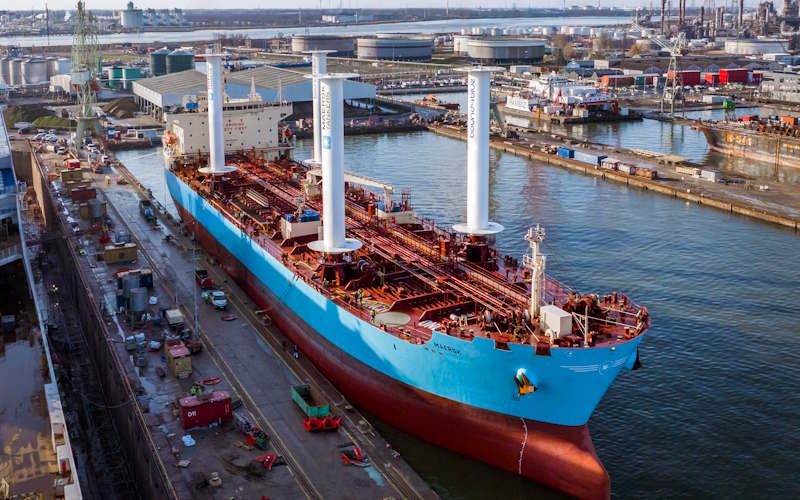
Spanish wind assisted propulsion (WASP) company bound4blue and Maersk Tankers have reached a milestone in their collaboration with the installation of eSail units on board the ‘Maersk Trieste’.
Four of the 24m ‘plug and play’ suction sails have been fitted on the vessel, completing the first stage of an agreement that will see a total of 20 units installed across five advanced medium-range (MR) tankers. The contract, agreed in December 2024, is bound4blue’s largest order to date.
José Miguel Bermúdez, CEO and co-founder, bound4blue, said this is “a watershed moment” in the further acceptance and adoption of wind power for an industry in transition. bound4blue’s autonomous eSails work by drawing air across an aerodynamically optimised surface to generate lift said to be up to seven times greater than conventional rigid sails of a comparable size. With configurations tailored for individual vessels, eSails have been found to deliver double-digit percentage reductions in fuel consumption and CO₂ emissions, while significantly improving a vessel’s CII rating. The systems unlock regulatory and cost benefits under frameworks such as FuelEU Maritime, via the Wind Reward Factor, and EEDI/EEXI.
Maersk Tankers, bound4blue and system integrator Njord chose a two-step installation process for the Maersk Trieste, maximising efficiency while minimising vessel downtime. Following preparatory ‘wind ready’ work carried out at Yiu Lian Shipyard in Shenzhen, China – including the installation of deck pedestals and electrical modifications – the vessel arrived at EDR Shipyard in Belgium. Here, the units were lifted onboard, secured to the pre-installed foundations, and connected to onboard power and data networks in a pre-commissioned ‘plug-and-play’ process. The mechanical simplicity of the design is considered to support straightforward integration into conventional shipyard workflows, helping to minimise downtime during retrofit projects.
Bermudez said: “Our system was designed from day one to deliver maximum performance with minimum complexity, and that’s especially important for scaling up installations within segments that present specific integration challenges, such as tankers. The size and efficiency of eSails enable tankers to benefit from wind propulsion safely and cost-effectively, without altering operational profiles – avoiding tilting systems and retaining a normal operational air draught, and all with the simplicity of a non-ATEX solution. These latest installations demonstrate that globally leading shipowners appreciate these benefits, while sharing our vision for a more sustainable, cost effective and compliant maritime future. We’d like to thank Maersk Tankers for this unique, important and powerful partnership.”
Claus Grønborg, CIO Maersk Tankers, added: “For the tanker industry, progress on emissions reduction requires concrete investments and implementation. At Maersk Tankers, we focus on deploying advanced energy-efficient technologies to reduce fuel consumption and CO₂ emissions. Implementing WAPS at scale enables more energy-efficient voyages for our customers, while supporting compliance with FuelEU Maritime and the EU Emissions Trading System.”
bound4blue’s DNV type approved technology is designed for simplicity and ease of integration on both newbuild and retrofit projects, across a range of ship types (including tankers, bulk carriers, ro-ros, cruise vessels, ferries, and gas carriers, amongst others). Installations can be undertaken to fit individual vessels and schedules, with streamlined processes enabling entire systems to be fitted in under a day, when necessary.
The Maersk Tankers project follows a series of high-profile eSail contracts and installations with shipowners such as Louis Dreyfus Company, Eastern Pacific Shipping, Odfjell, Klaveness Combination Carriers, and BW Epic Kosan. Taken together, these projects are thought to provide further proof that wind propulsion is rapidly moving from niche innovation to mainstream decarbonisation strategy – driven by tightening regulations, rising fuel costs, and growing industry confidence in the technology’s commercial benefits.
Bermudez concluded: “This is more than just another installation. It’s proof that wind propulsion is ready to deliver at scale, even for complex vessel types like tankers. By partnering with a forward-thinking company like Maersk Tankers, we’re showing that practical decarbonisation solutions are already here… and ready to make a measurable impact today.”
Image: ‘Maersk Trieste’ can now take advantage of reductions in fuel consumption and CO₂ emissions (source: bound4blue)