
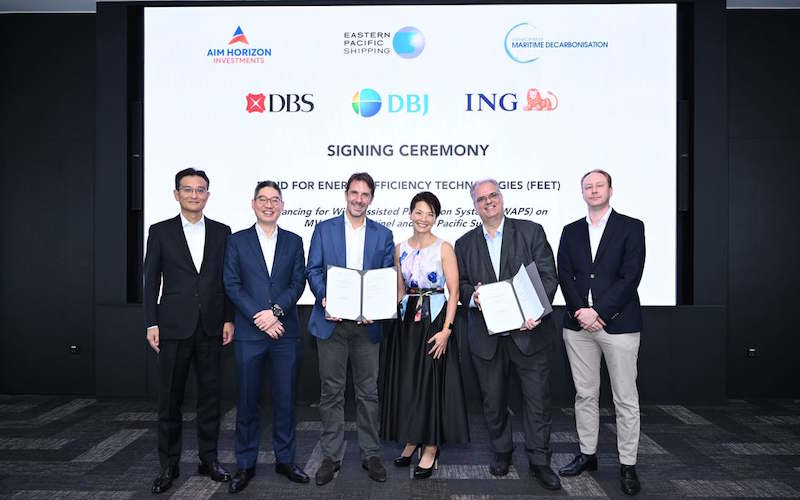
The Global Centre for Maritime Decarbonisation (GCMD), AIM Horizon Investments, and Eastern Pacific Shipping (EPS) have jointly announced the financing for two wind-assisted propulsion systems (WAPS) projects through the Fund for Energy Efficiency Technologies (FEET), marking the fund’s first deployment.
FEET is the first fund to link verified fuel and regulatory savings from EETs installed on vessels to a pay-as-you-save mechanism. It offers up to 100% upfront financing through a blended finance structure. FEET is managed by AIM Horizon Investments, with GCMD as the fund’s decarbonisation advisor. It is also supported by the Development Bank of Japan, DBS Bank and ING.
The fund’s first deployment finances the wind-assisted propulsion systems on board Pacific Sentinel and Pacific Sunstone. Each has installed three 22m suction sails on board, making them the first vessels in the EPS fleet to use WAPS.
This deployment builds on an earlier collaboration between GCMD and EPS which led to the development of a methodology for quantifying fuel savings from the WAPS installed onboard the Pacific Sentinel. To isolate the retrofit’s impact from changes in operating conditions, GCMD collected 276 million data points over four months of spot-market trading in the Americas, from mid-May to mid-September 2025. From these, 203 valid on-off transitions were screened to quantify performance.
Going forward, FEET will apply this methodology, reviewed by an independent third party, to determine fuel savings for the WAPS projects it finances. The project data will be audited, and the calculated fuel savings independently verified. These verified savings will then be used to determine payments from shipowners.
Prof Lynn Loo, CEO, GCMD, said: “Scaling EETs depends not just on proving that they work, but on establishing how much fuel they save under real-world operating conditions. With a methodology now in place to quantify those savings, FEET’s first projects with EPS take the next step: testing how pay-as-you-save financing works in practice, by linking payments to verified fuel savings. This is how we aim to turn operational evidence into investor confidence and unlock wider adoption of EETs across fleets.”
Marcel de Bruijckere, CEO, AIM Horizon Investments, added: “Launching an innovative fund like FEET required a lot of effort, strong co-operation with GCMD and support by anchor investor Development Bank of Japan and debt providers ING and DBS Bank. The first deployment of FEET’s capital makes all that hard work worth it and delivers the proof of its concept. We learned a lot from our interaction with the finance and technical teams of EPS and look forward to applying those lessons when making our next investments and scaling up the fund.”
Cyril Ducau, CEO, EPS, concluded: “Decarbonisation moves faster when the technology, the data, and the financing come together. Pacific Sentinel has shown what wind-assisted propulsion can do in real operations, and we are pleased to now showcase this first FEET financing designed to assist shipowners wanting to invest in proven solutions. We look forward to seeing more energy efficient technologies make their way onto ships.”
Image: L-R: Miki Akita, Development Bank of Japan; Max Lim, DBS; Cyril Ducau, EPS; Lynn Loo, GCMD; Marcel de Bruijckere, AIM Horizon Investments; and Jens Van Yperzeele, ING (source: Global Centre for Maritime Decarbonisation)