
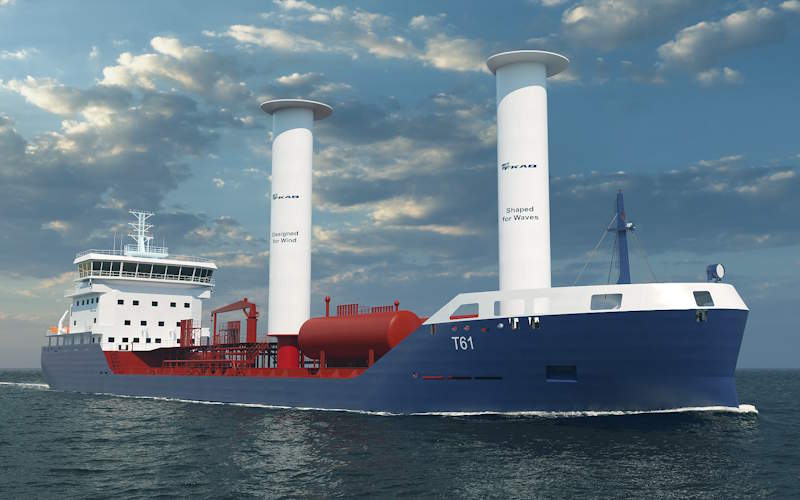
According to Swedish ship designer FKAB, wind-assisted propulsion is emerging as one of the most promising energy-saving technologies in shipping.
However, successfully integrating wind propulsion systems (WAPS) is not considered by FKAB as simply a matter of installing sails; it requires a vessel designed from the outset to operate efficiently with wind-assisted propulsion. The T61, a 7000 dwt stainless steel chemical and product tanker has therefore been developed with wind integration as a core design principle. The concept is intended to combine high operational efficiency today with flexibility to adapt to future energy solutions.
The vessel features an optimized hull form with FKAB’s F-Bow, improving seakeeping in rough conditions while reducing resistance. This is considered particularly important for vessels operating with wind propulsion, where improved behaviour in waves directly influences overall performance.
Even without wind-assisted propulsion or other energy-saving devices, the vessel demonstrates strong inherent efficiency. At 11.5 knots, the T61 concept is estimated to consume approximately 7t of fuel per day at 80% MCR, including 150kW electrical load and a 15% sea margin. The preliminary EEDI performance is well within the IMO requirement, even when calculated without sails or other energy-saving technologies and including a 5% engine maker tolerance. Depending on fuel choice, the attained EEDI ranges between 6.72 and 8.76, compared with a required value of 15.08, providing a significant margin for future regulatory developments.
The design includes structural preparation for wind-assisted propulsion systems such as suction sails, rotor sails or wing sails. Two sails are expected to provide a combined mean saving of approximately 290kW, corresponding to roughly 1.2t of diesel fuel per day.
Because wind propulsion performance is highly dependent on operating conditions, FKAB has performed advanced wind studies, analysing wind statistics, trading routes and operational profiles. These studies determine whether wind-assisted propulsion can deliver meaningful savings on specific trades and help identify the most suitable sail technology.
The propulsion system is designed as a hybrid arrangement supported by a substantial battery installation. The vessel is equipped with 6MWh of battery capacity for peak shaving, UPS functionality and operational flexibility. Additional space is reserved for a further 3MWh of battery capacity, allowing the system to expand to 9MWh as operational needs or regulatory requirements evolve. With preparation for wind propulsion, hybrid power integration and future fuel solutions, the T61 is designed to provide shipowners with a vessel platform that combines efficiency today with adaptability for tomorrow.
Image: T61 product tanker design, featuring WAPS as standard (source: FKAB)