
Fortescue Executive Chairman Dr Andrew Forrest AO has welcomed the landmark carbon pricing agreement reached by the IMO, describing it as clear evidence that when industry is at the table, global cooperation can actually work – and drive serious economic change where politics usually stalls.
The IMO’s 176 member states have achieved a framework aimed at significantly reducing emissions across the global shipping sector. This includes a worldwide carbon pricing mechanism and fuel standards that address emissions across the entire fuel lifecycle. The revenue from carbon-related fuel levies is expected to reach approximately US$ 10bn annually by 2030, and will be used to support the adoption of low-emissions fuels and to build the infrastructure needed for the transition.
Forest said: “This is a major victory. It represents one of the most significant climate achievements by any heavy industry. The global shipping sector has demonstrated what can be achieved through courage, conviction, and international cooperation. It has set a powerful example that others must now follow.”
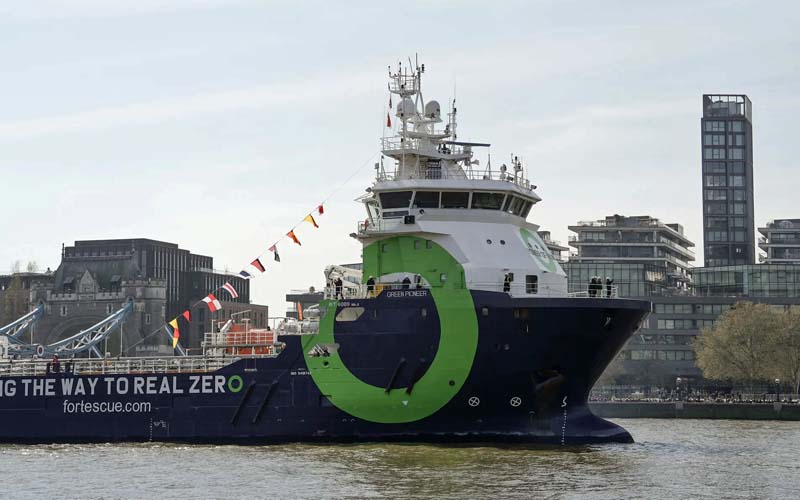
Fortescue has played a leading role in advocating for rapid uptake of zero-emissions fuels, including green ammonia, through its work with the IMO and its demonstration vessel, the Fortescue Green Pioneer. Although the IMO agreement has attracted strong sectoral support, Fortescue acknowledges the deeply felt disappointment of Small Island Developing States (SIDS), which had called for a universal carbon levy and more robust financing commitments. These nations face the most severe and immediate consequences of fossil fuel dependence. Despite the progress, a number of petrostates opposed the final agreement, seeking to weaken its ambition and delay implementation.
Forrest continued: “Take just one example: Saudi Arabia is a regional leader with the capacity to unlock practical climate solutions in one of the world’s most climate-vulnerable regions. The Kingdom sits at the crossroads of a global energy transition and a rising humanitarian imperative. It is a country with tremendous potential to lead the path to full decarbonisation rather than simply forestall the energy transition. Climate science research conducted by the University of Western Australia shows that during the 2024 Hajj, heat and humidity breached the limits of human survival for over 43 hours, contributing to the deaths of more than 1,300 pilgrims. This is a moment for bold leadership. We call on Saudi Arabia to use its influence to drive consensus, not disrupt it, and to chart a path that secures the wellbeing of its people and the future of the region.”
Forrest highlighted the significant leadership shown by nations that prioritised global cooperation over narrow political interests.
He said: “In this crucial COP year, Brazil has demonstrated the kind of principled climate leadership the world urgently needs. Alongside China, it acted with vision, courage, and a deep sense of responsibility – not just for its own citizens, but for all humanity. Petrostates, particularly Saudi Arabia, must be held to account if they set out to destroy – not deliver – multinational agreement and solutions to climate destruction that fossil fuel is causing.”
Forrest called on other high-emitting sectors, particularly in mining and steel, to meet the same level of ambition and accountability displayed by the shipping industry.
Image: Fortescue’s ‘Green Pioneer’ ammonia-fuelled demonstration vessel (source: Fortescue)