
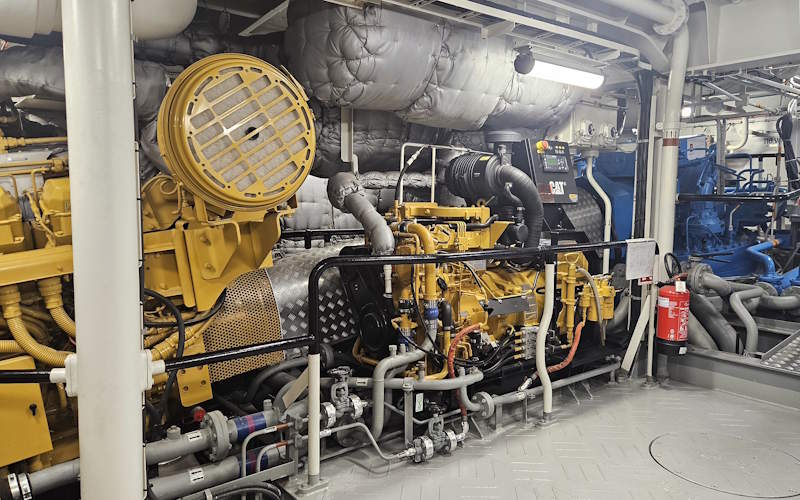
UAE-based marine automation and performance optimisation specialist Voyage Marine has announced the results of a controlled maritime engine trial undertaken in collaboration with fuel technology company, Fuelre4m.
The Re4mx Diesel product was demonstrated to have delivered an 8.7% fuel saving with a 5% increase in bollard pull, alongside improved combustion stability and emissions reduction under load during testing.
The 12-hour trial was conducted on a working vessel equipped with twin Caterpillar 3512C main engines. Testing was carried out under real operating conditions, with the same base fuel used throughout and no retrofit, hardware, or software modifications made to the vessel. The only variable introduced during the trial was the addition of the Re4mx Diesel product.
During the Re4mx-dosed sequence, both engines consistently delivered 3–5% higher thrust across measured load steps, achieved at the same or slightly lower rpm. This increase in effective propulsive power directly supported the measured 5% increase in bollard pull. At the same time, fuel demand fell. ECM fuel-command values in the operationally significant 50–70% load range were notably lower, aligning with the measured 8.7% reduction in fuel consumption for increased power.
Mechanical indicators confirmed improved combustion. Crankcase pressure decreased, indicating reduced blow-by and improved piston-ring sealing, while exhaust-gas temperatures became more stable, reflecting more consistent combustion and an expanded, more usable power band.
Emissions data further supported the findings. Lower CO levels and stable O₂ and CO₂ behaviour indicated a more complete combustion process, with improvements most evident under load. Tank-level readings, while not used to calculate fuel consumption, moved less during the dosed sequence and aligned directionally with the performance data.
These results are considered to indicate a cleaner, more complete combustion process and an expanded, more usable power band under operational conditions.
Anilkumar Earath, GM Operations, Voyage Marine, said: “From a measurement and verification standpoint, the trial was conducted in a controlled and repeatable way on a working vessel. The results showed consistent gains in thrust, lower fuel-command values and improved combustion stability without any hardware modification or change to the base fuel.”
Fuelre4m CEO Rob Mortimer added: “These results are extremely encouraging and show that our fuel technology can reduce fuel demand and improve vessel performance using the engines and fuels operators already have. For owners and managers facing decarbonisation and regulatory pressure, this offers a practical solution that can be implemented now whilst the industry continues its transition toward future fuels.”
Fuelre4m believes the findings demonstrate the potential for performance-enhancing fuel treatments to deliver measurable efficiency gains in existing marine engines without modification. In an environment of increasing decarbonisation targets and regulatory pressure, solutions that can be implemented within current fleet configurations are believed to be of growing interest to vessel owners and operators.
Image: Engines and onboard fuel system used during testing on a tug at Voyage Marine (source: Fuelre4m)