
According to HD Hyundai of South Korea, global efforts to achieve carbon neutrality and strengthen energy security are accelerating, with the result that nuclear power is drawing increasing attention as a carbon-free energy source.
At the same time, heightened concerns over the safety and public acceptance of large-scale reactors are driving a market shift toward small modular reactors (SMRs). According to a SMR market report by global research firm MarketsandMarkets, the global SMR market is projected to grow from US$ 5.7bn in 2022 to US$ 6.8bn by 2030, with an average annual growth rate of 2.3%.
HD Hyundai says is fast-tracking its investment in SMR technology development, positioning the company at the forefront of next-generation clean energy innovation, including nuclear ship propulsion.
HD Korea Shipbuilding & Offshore Engineering (HD KSOE) is an investor in TerraPower, a US SMR company founded by Microsoft co-founder Bill Gates. The US$ 30m investment marked the company’s full-fledged foray into the next-generation energy technology. Founded in 2008, TerraPower developed the Natrium reactor, a next-generation sodium-cooled fast reactor (SFR) design. As global energy demand continues to surge, TerraPower is moving swiftly to deploy Natrium reactors across the US and beyond. Recognised as one of the most advanced SMR types, SFR technology is said to offer enhanced safety, a high level of technological maturity, and to generate only about one-twentieth (5%) of nuclear waste compared to conventional reactors.
HD Hyundai expects to play a key role in establishing the foundation for the commercial deployment of Natrium reactors. The company has signed a strategic agreement with TerraPower to expand the manufacturing supply chain for the commercialisation of the Natrium reactor, with HD Hyundai developing manufacturing solutions for key reactor components.
As well as development of a floating nuclear power barge, an offshore power generation platform designed to produce electricity using SMR technology, HD Hyundai is partnering with TerraPower on a range of initiatives, including the development of nuclear-powered vessels. Additionally, HD Hyundai is advancing development of the Molten Salt Reactor (MSR), considered one of the most suitable reactor types for offshore nuclear power generation. MSR is a type of Small Modular Reactor (SMR) that uses molten salt at high temperatures as both a coolant and a fuel medium. HD Hyundai is exchanging MSR technology with TerraPower, Southern Company from the US and Core Power from the U.K.
HD Hyundai is developing its first nuclear-powered vessel. The company sees nuclear propulsion as a potential game changer in the shipbuilding industry, offering a breakthrough technology for achieving carbon neutrality.
Park Sangmin, KSOE Green Energy Research Laboratory Head said: “The global market for SMR-powered ships is a blue ocean, free from competition with China.”
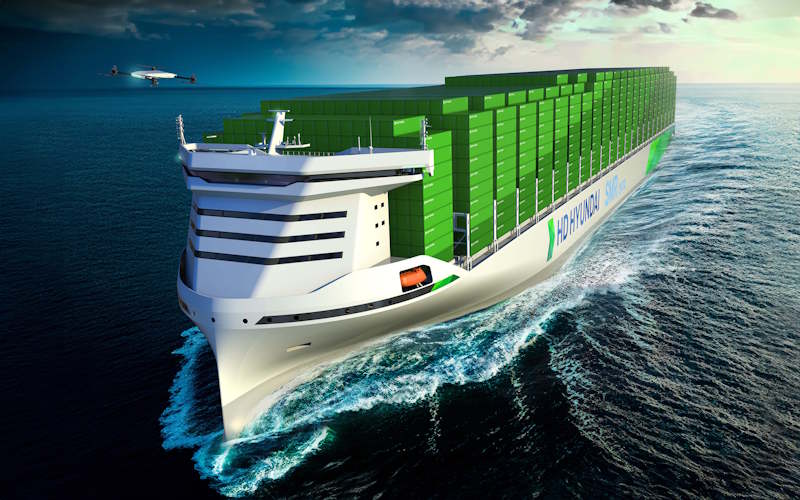
The company is currently developing a 15,000 TEU-class container vessel powered by an MSR engine system. Development is said to be about 50% complete, with the goal of full-scale completion by 2030.
Unlike conventional ships, nuclear-powered vessels do not require components such as exhaust systems or large fuel tanks, allowing the additional space to be used for additional cargo, significantly improving operational efficiency. The design incorporates advanced safety systems to enhance reliability.
HD Hyundai has received approval in principle (AiP) from ABS for its 15,000 TEU SMR-powered container ship concept.
Image: Rendering of a 15,000 TEU container ship powered by SMR (source: HD KSOE)