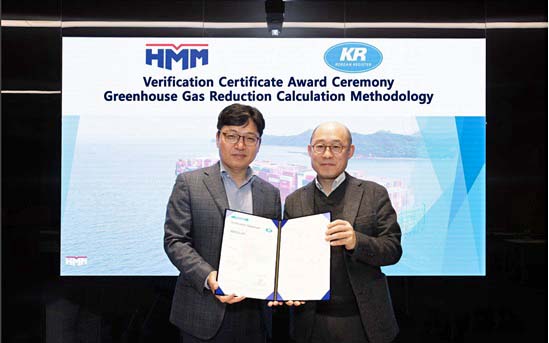
Korean Register (KR) has awarded a third-party verification certificate for a ‘Greenhouse Gas Reduction Calculation Methodology’ developed by HMM, South Korea’s largest shipping company.
The methodology is based on the EU’s Renewable Energy Directive II, a regulatory framework adopted to promote the use of renewable energy to all member states. In 2023, IMO set the international shipping industry the goal of achieving net zero carbon emissions by, or close to, 2050. Discussions on the Life Cycle Assessment (LCA) methodology for marine fuel oil are underway, accelerating the movement towards carbon neutrality.
The GHG reduction methodology verified by KR involves calculating the amount of reduced greenhouse gases based on the fuel’s life cycle emissions (WtW, Well-to-Wake), which includes WtT (Well-to-Tank) and TtW (Tank-to-Wake) emissions. HMM uses this verified methodology in its ‘Green Sailing Service’. This service aims to help shippers and stakeholders reduce Scope 3 carbon emissions, by allowing them to report carbon reductions directly resulting from HMM vessels sailing on low-carbon fuels.
In response to current regulatory changes, shipping companies are searching for suitable alternative fuels and their efficient application. Biofuel, a blend of biodiesel from used cooking oil and standard marine oil, is gaining traction due to its compliance with IMO regulations without necessitating engine modifications.
HMM is at the forefront of adopting biofuel, collaborating with GS Caltex and KR. in 2023 HMM marked a significant milestone with the successful biofuel trial on its 6,400 TEU container ship, HMM Tacoma.
Song Kanghyun, Head and SVP, KR’s decarbonisation ship R&D centre has emphasised KR’s commitment to aiding shipping companies in adhering to GHG regulations through the proactive development of alternative fuel technologies and the monitoring of international regulations.
Image: Song Kanghyun (left), and Kim Shin (right), Chief Container Business Officer, HMM (source: Korean Register)