
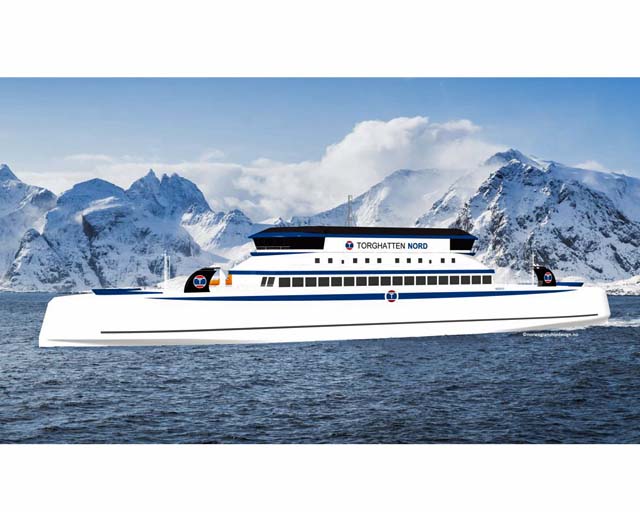
Norwegian ferry operator Torghatten Nord has signed a contract with the Norwegian Public Roads Administration to operate hydrogen ferries between Bodø and Lofoten from 2025.
Torghatten Nord will build two new hydrogen vessels for delivery by the start of the contract in October 2025, and will convert the existing vessels delivered in 2012 from LNG to other low-emission solutions.
Torghatten Nord CEO Torkild Torkildsen said:”I am proud that Torghatten Nord will develop and operate hydrogen ferries on Norway’s longest and most weather-exposed ferry route. We are now given responsibility for a world-class climate project that opens concrete and exciting opportunities for green sea transport globally, new industry in Norway and local business. But everything we do from ground-breaking work must be based on safety, operational stability and good travel comfort for our passengers.”
Torghatten Nord points out that the pioneering work that is now being started to develop and operate The hydrogen ferries will have ripple effects for the Norwegian hydrogen industry, the maritime industry and for Lofoten as a destination.
Torkildsen said: “We are investing in hydrogen now, but there is no one to sell to. We will become the first major buyer of hydrogen in Norway, thanks to the Norwegian Public Roads Administration’s and the government’s climate-offensive decisions. This also provides significant opportunities for the shipyard and equipment industry to participate competence development in the use of hydrogen as an energy source. For tourism, the hydrogen ferries will also be a unique opportunity to take the tourism investment and the international brand Lofoten one step further.”
EQT, which owns the Torghatten Group, sees the contract as a milestone.
“This contract represents a milestone, not only for Torghatten, but also for EQT. We have set ambitious goals to cut greenhouse gas emissions, and Torghatten gets a hero with this contract special position among our portfolio companies. They are already world leaders in development and operation of low-emission ferry transport solutions, but will now take the lead in developing hydrogen as energy source for transport in Norway. The project will also be very important globally, reaching the maritime transport sector will switch to net zero emissions,” said Carl Sjölund, partner in EQT Infrastructures Advisory Team and responsible for EQT Infrastructure V’s investment in Torghatten and Molslinjen.
Torkildsen is aware of the responsibility to ensure the operational safety of the ferries outside the summer season, which means a lot to the locals and the fishing industry:
“Then we never forget that this is the lifeblood of the people and fishing industry on Værøy and Røst. Therefore the new ferries could run on alternative fuel, and we have good quality spare ferries,” he said.