
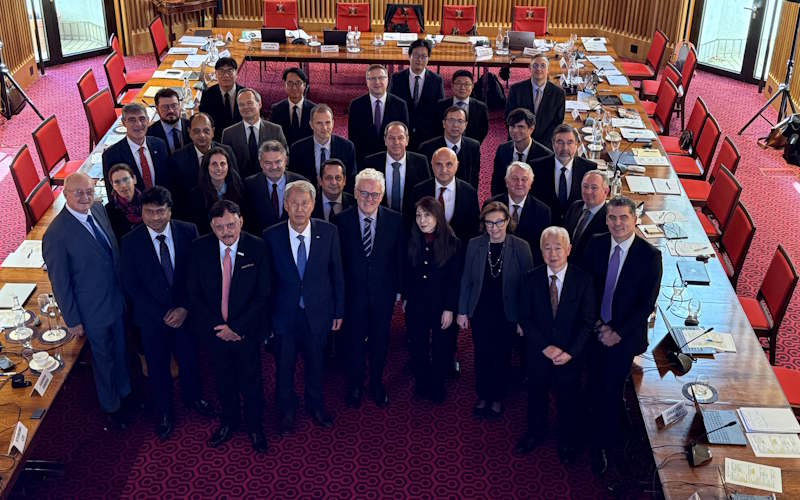
At the recent 92nd meeting (C92) of the Council of the International Association of Classification Societies (IACS) in London, the council reviewed the significant outputs from its safe decarbonisation and safe digital transformation panels, the progress made on the evolution of the common structural rules, and to reaffirm the centrality of quality to classification societies’ work.
The Council said a fond farewell to its outgoing Chair, Roberto Cazzulo who has now completed his term of office.
On Safe Decarbonisation, C92 welcomed the near finalisation of unified requirements (URs) for ammonia release mitigation system and approval of lithium batteries, alongside a recommendation for the use of portable tanks for containment of hydrogen fuel onboard ships. In addition, C92 noted that URs for the installation of carbon capture systems and on ESD systems and valves on bunkering manifolds for methanol/ethanol bunkering vessels are in their final stages as is an IACS recommendation on guidelines for gas dispersion analysis.
IACS Council was equally satisfied with the extensive progress made by IACS’s panel on safe digital transformation and discussed the ongoing revision of its common structural rules (CSR). IACS Council undertook a strategic assessment of the Association’s quality objectives as part of its commitment to continuous improvement and in anticipation of a number of external developments, such as new Port State Control scoring methodologies, that may impact IACS membership rules (which all members must comply with at all times).
C92 marked the completion of Cazzulo’s two-year term of office, and elected his successor whose name will be announced in early 2026.
Cazzulo said: “Overseeing IACS’ development and delivery of a wide range of resolutions that meet the key twin challenges of decarbonisation and digitalisation has been at the core of my tenure as Chair. These significant technical contributions demonstrate IACS’ ability to support regulators and industry and address innovative and complex regulatory and technical challenges without any reduction in the scope and speed of its more traditional work programme.”
IACS was pleased to welcome representatives from a wide range of industry associations to provide updates on matters of joint interest and to assess and advance the extensive programme of Joint Industry Working Groups established by Tripartite.