
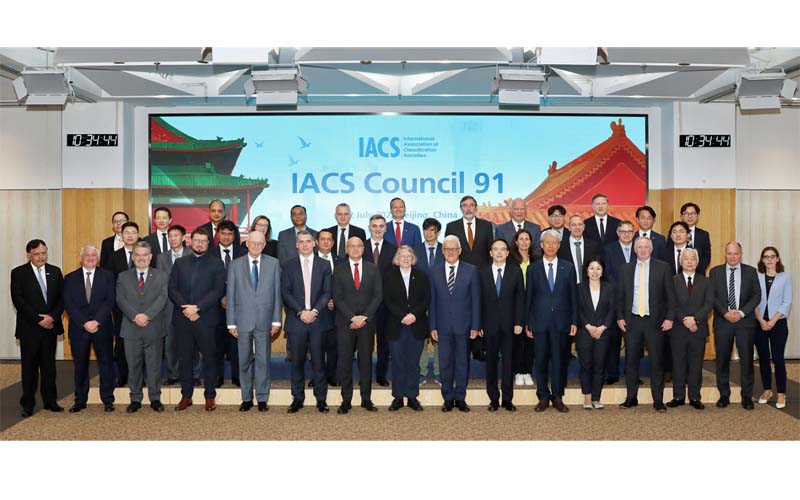
The International Association of Classification Societies (IACS) 91st council meeting (C91) in Beijing assessed and advanced the association’s progress on safe decarbonisation and digital transitions, as well as the further development of common structural rules (CSR), and various other joint initiatives currently underway with industry partners.
C91 took the first steps towards integrating environmental, social and governance (ESG) principles into IACS’ governance. The council further agreed an internal framework of structured engagement with the International Quality Assessment Review Body (IQARB) to ensure IACS support for its objectives.
Three years after the launch of its safe decarbonisation panel, the IACS council welcomed the rapid progress made in developing technical guidance across a range of key technologies that support the introduction of new fuels and technologies on both new builds and the existing fleet. In line with IACS’s technology-neutral approach, IACS instruments now cover ammonia, methanol, hydrogen, batteries and carbon capture, while also working with flag states on matters such as gas dispersion analysis and risk assessments for alternative fuels as required by the IGF code. The council welcomed IACS’ preliminary work in assessing its potential role in the introduction of nuclear technologies.
IACS council recognised the close interaction with other industry bodies in these areas, noting the work with CIMAC to advance digital discussions at IMO, with BIMCO on automated fuel consumption data gathering (to name two) and IACS’ involvement in the many joint industry working groups, ranging from anchoring equipment to underwater radiated noise.
IACS Council Chair, Roberto Cazzulo, said: “IACS ability to deliver on its core mission of delivering substantive, detailed, technical contributions to the full range of industry discussions was reflected in the range of IACS instruments that C91 was invited to consider. Our association’s sustained leadership can be seen in our discussions on the decarbonisation and digital transitions, ESG and IQARB, while our commitment to working with industry partners manifests itself in our strong commitment to joint industry groups and in our flexible, responsive approach to evolving the common structural rules.”
Image: The 91st council meeting since the founding of IACS in 1968 was held in Beijing, hosted by the China Classification Society (source: IACS)