
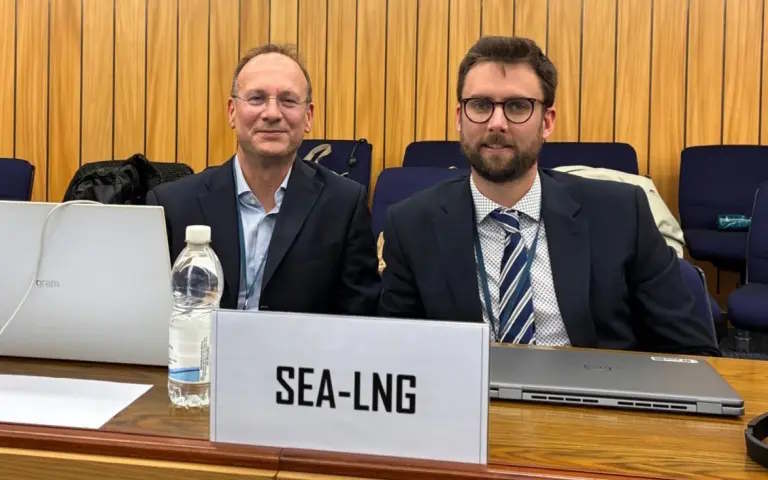
Methane industry collective Sea-LNG has reported from IMO’s recent ISWG-GHG 22 meeting at IMO HQ in London, which was Sea-LNG’s first IMO meeting as an accredited participant.
The meeting was never expected to rewrite the IMO Net-Zero Framework in four days. Instead, it was about restarting the conversation after 2025’s suspension, testing where positions have moved and identifying whether there is still a credible route towards convergence.
The discussion was structured around five core building blocks:
- GFI calculation and certification,
- the GFI reduction pathway,
- compliance approaches,
- the possible Fund/Facility, and
- ZNZ rewards.
Across all five, the debate showed both how difficult the negotiation remains and how much it has matured. Sea-LNG found that technology neutrality is becoming even more important. OCCS moved firmly into the GFI discussion, with growing interest in recognising verified ship-level emissions reductions. On ZNZ rewards, the principle should remain equally clear: reward verified lifecycle GHG reduction, not a preferred fuel or technology pathway.
Flexibility will matter. The discussion on Surplus Units, pooling, borrowing and netting showed increasing recognition that actual GHG reduction must remain the primary route to compliance, but ships will need workable flexibility around it. Much of this reflects what Sea-LNG has long advocated, solutions must be fuel agnostic and practical and realistic.
The Fund debate is changing. The conversation is becoming less binary than simply ‘Fund or no Fund’ and more focused on what functions are actually needed, how they should be financed and what role IMO should play.
And importantly for Sea-LNG, the methane pathway remains part of the conversation. Sustainable biomethane is already being deployed, synthetic methane can progressively follow, and both can make use of existing ships, gas grids, terminals and bunkering infrastructure. The regulatory framework should assess those pathways on their verified lifecycle performance, not predetermine how long they are allowed to play a role.
At first sight, revisiting some of these questions may look like a step backwards. In reality, the debate is more specific, more informed and more grounded in the practical realities of implementation than it was two years ago. According to Sea-LNG, the direction of travel is still not clear. But there is more openness today to finding a workable compromise than there was six months ago. For industry, that matters. The transition has not paused while regulation is being negotiated. Ships are being ordered, infrastructure is being built, fuels are entering the market and investment decisions are being made today for assets that will operate for decades.
The challenge now is to build a framework that gives industry the certainty to accelerate that transition, without unnecessary complexity, without regional fragmentation, and without picking winners and losers.
Image: Sea-LNG at IMO (source: Sea-LNG)