
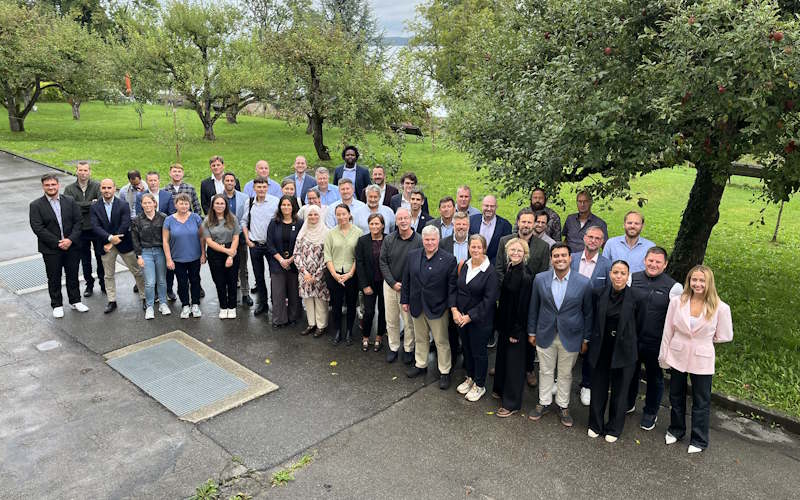
The In Port Inspection & Cleaning Conference (PortPIC), driven by Jotun and VB conferences and supported by industry sponsors, recently held its sixth annual conference in the Bernried monastery at the Starnberg Lake in Germany.
It attracted 50 participants from port and ship operators, antifouling technology suppliers, robotic in-water cleaning companies, regulators and academia.
Advances in biofouling management and in-water cleaning were on the agenda. Progress is being made but there’s much more work to be done warn experts as the IMO moves towards mandatory regulation.
With hull fouling accounting for a 7-10% increase in fuel consumption (and therefore emissions), solving the problem goes a long way to reducing emissions without a need for levies. The many speakers and panel discussions at PortPIC addressed various aspects of antifouling measures and in-water cleaning of hulls, including regulations and compliance, as well as technical developments and practical implementation of robotic cleaning systems and other solutions.
In the lead up to the conference, Volker Bertram of DNV said “Biofouling management and in-water cleaning are important means to improve the ships’ performance and protect the environment, but they come with their own challenges, not least around safety and sustainability. Also, a biofouling management system must be practical and cost-effective.”
He continued, “PortPIC brings together relevant stakeholders to discuss regulatory, technical and economic issues in an open and collaborative manner. Progress is being made but there is still a long road ahead. Guidelines are turning into standards, standards into mandatory rules and conventions.”
Indeed, at a time when interest in the impacts of biofouling on efficiency and biodiversity is surging, the IMO has recently updated its guidelines on the subject with mandatory regulations being widely predicted for the near future.
This is likely to add pressure on owners, building on the regulatory action against ships with fouled hulls already taken by a number of states including New Zealand and Australia with Norway planning to join them in 2028.
A need for standards recognised
At least the need for international standards connected to new regulation has been recognised in advance as there are two ISO standards relating to in-water cleaning (IWC). ISO 20679:2025 covers testing of IWC systems and the soon to be published ISO 6319 outlines how to conduct and document IWC cleaning operations.
“As regulations tighten and industry moves toward a global framework, the need for strategic biofouling management has never been greater. Ensuring that the industry is aware of and understands the solutions and technologies is important, also in terms of how they can help the industry decarbonize, protect diversity, and optimize fuel efficiency,” said Petter Korslund, regulatory affairs manager at Jotun. He also highlighted how the Biofouling Guidelines and IWC guidance issued by the IMO stresses the importance of a management strategy centred around prevention, monitoring and timely interventions in building a sustainable path.
Korslund also made a presentation based around Jotun’s recent survey report on biofouling. The study, based upon a survey of 1,000 shipowners, highlighted that around 40% of ship owners have experienced regulatory penalties due to biofouling related issues and a similar number denied port access due to non-compliance issues related to biofouling. “Today half (49%) of those surveyed told us they avoid ports with stringent biofouling regulations, a strategy that becomes increasingly unsustainable as global standards continue to tighten,” said Korslund. Also commenting on the study, Morten Sten Johansen, Global Category Director Hull Performance in Jotun said the survey results are a stark reminder of the cost of being unprepared.
Irene Øvstebø Tvedten of the Norway-based Bellona Foundation made a presentation titled, How Far Are We from an Internationally Harmonised Regulatory Framework for Biofouling Management? “At Bellona, we are encouraged by the ongoing developments in biofouling management. New coatings, in-water cleaning systems, and other promising technologies are continually being tested, analyzed, and refined.”
“However, time is ticking” she warned and highlighted the move towards mandatory regulation. As well as the new ISO standards and the IMO guidelines, she pointed out that at MEPC 83 in April, the IMO member states agreed to develop a legally binding framework for the control and management of ships’ biofouling.She also emphasised the need for a science-based and efficient process.
Another paper by Mark Riggio, Ballastwater & Environmental Manufacturers’ Association (BEMA) also explored this theme and covered how BEMA has launched a global Biofouling Research and Data Development initiative designed to support evidence-based policy formation.
Balancing hull performance with environmental responsibly and how cleaning methods avoid harming coatings or water quality were also discussed at the conference.
Compatibility of coatings and cleaning systems explore
Practical considerations around the compatibility of in water cleaning systems and coatings was explored in a presentation by Anita Børve, R&D senior chemist, Fouling Protection at Jotun. It is clearly obvious that a cleaning system that damages coatings is not a good thing and indeed this matter is also addressed in the new IMO guidance and in ISO 20679.
The IMO guidance says, “the compatibility should be determined and documented based on testing at specified fouling ratings”. This is important as a system that works fine on slime or micro-fouling may cause damage to the coating if used on macro-fouling. The ISO 20679 standard requires that observations on the physical condition of coatings should be recorded and reported using means such as photos or videos. Observation would cover visible damage such as scratches, bare metal, pitting and paint flaking among others and suggests measurement of dry film thickness as an optional alternative.
Jotun’s research paper reported on the proven compatibility of Jotun’s HullSkater and its SeaQuantum Skate coating and also covered the testing around water quality before and after cleaning on a number of in-service vessels. These tests showed there were elevated levels of metals, organics and particulates when incompatible coatings and coatings in poor condition were cleaned. Jotun concluded that while water testing can confirm compatibility or otherwise, it cannot quantify the degree of incompatibility.
Perspectives from ports and shipowners
A port authority perspective on in-water cleaning was given in a paper presented by Jørn-Erik Hausmann of the port of Bergen. Along with the port of Oslo, Bergen has implemented a ban on in-water cleaning unless the equipment used is pre-approved and includes capture of all debris produced during cleaning.
The paper covered a pilot project began this year which is aimed at refining the procedure into a practical method both ex-situ and in-situ testing. This should align with draft requirements issued by the Maritime Authority in Norway for all ships entering Norwegian waters, as well as for all vessels conducting in-water cleaning activities within Norwegian territorial waters.
The question of whether or not to only approve in-water cleaning systems that employ capture is one that has sparked debate. As acknowledged in the paper, IMO has recognized that there is not yet sufficient scientific evidence and global consensus to set discharge standards for waste substances based on specific concentrations. A complete capture and/or no impact on the coating is not technologically achievable. IMO have therefore adopted a statistical approach whereby concentrations of each substance near the cleaning unit and in any cleaning system effluent should not be significantly increased relative to ambient levels.
The port of Bergen is allowing a cleaning equipment without capture to be used if the coating does not release waste substances during cleaning and if it can be justified that an equipment will not clean any area that contain macrofouling or non-native organisms.
Whatever regulations are eventually formulated, it will be down to operators to best decide how to comply with them. A paper presented by Jean-Loup Barrere of French ship operator CMA CGM described the shipowners’ perspective. The paper looked at the history of hull fouling and methods to combat it and the practical issues around in-water hull cleaning.
CMA CGM is of the opinion that proactive cleaning that prevents biofouling from gaining a foothold is the best option as it eliminates the biodiversity threat and ensures an efficient ship that will use less fuel and hence lower emissions. The paper also looked at some of the problems with cleaning in ports, pointing out that the side of the ship against the wharf is inaccessible to cleaning systems, that ensuring any system that is carried onboard is approved by all ports likely to be visited. Jean-Loup Barrere also commented, “the best solution would be a proactive cleaning system which would work fully autonomously during transit, but no such system is currently available on the market.”
The papers presented at PortPIC and developments in the industry demonstrate that it is reasonable to assume that because biofouling has such a direct impact on bottom line financial figures, the shipping industry will be less hostile towards regulation than it has been towards some other issues in the past. Also, using robots carried onboard or accessible at strategic locations will make proactive cleaning easier and cheaper than in the past. That is a win-win situation, operators benefit from lower fuel bills and less levies and the environmental benefits by eliminating species transfer at the same time.
Progress being made but much more work to be done
PortPIC concluded with a forum discussion where the general consensus was that “the good mix of different perspectives and expertise discussed in an open, and solution-oriented manner made this arguably the best PortPIC ever” said the forum moderators Bertram and Korslund.
The forum reflected that robots are coming, but only gradually and best practice is often still hybrid with a mix of divers and robots/ROVs. Still, great progress in inspection in the last decade was widely seen as in “drones” with falling prices, rising capabilities.
And the participants agreed the industry is marching towards and preparing for mandatory in-water cleaning, but the “devil is often in the detail” and while there are guidelines and standards, there is a need for detailing interpretations, instructions on how to do the real-world processes. For example, what is “effective” cleaning and how do you measure it reliably and fairly?
Also, views were expressed that compatibility (between coating and cleaning process/materials) is being anchored in the minds and standards, and that there is significant progress in awareness in the industry. However, proactive cleaning (commonly known as grooming) is still more of a vision than reality even for large and renowned shipping companies.
On a more positive note, knowledge on best practices for in-water cleaning is increasing, but implementation in industry practice is a thorny and slow process, not least because of diverging financial interests between stakeholders such as time charterers and shipowners. Also, the forum voiced the opinion that IMO should oblige Port States to allow (regulated) in-port cleaning, but this endeavour is likely to face resistance from some states.
“Clearly different stakeholders will have different interests, and they may have varying opinions in terms of the solutions. But at the end of the day, we’re all moving in the right direction because we all acknowledge there’s no ‘silver bullet’ to solving the global biofouling problem and there’s a need for more collaboration and innovation,” said Jotun’s Morten Sten Johansen and concluded, “To this end, PortPIC is a vital platform and we remain committed to adding value to the biofouling debate, and making continued progress towards clean, sustainable shipping.”
For more information on the topics covered and related-papers see proceedings here.
Image: The In Port Inspection & Cleaning Conference (PortPIC attracted 50 participants from port and ship operators, antifouling technology suppliers, robotic in-water cleaning companies, regulators and academia (source: Jotun)