
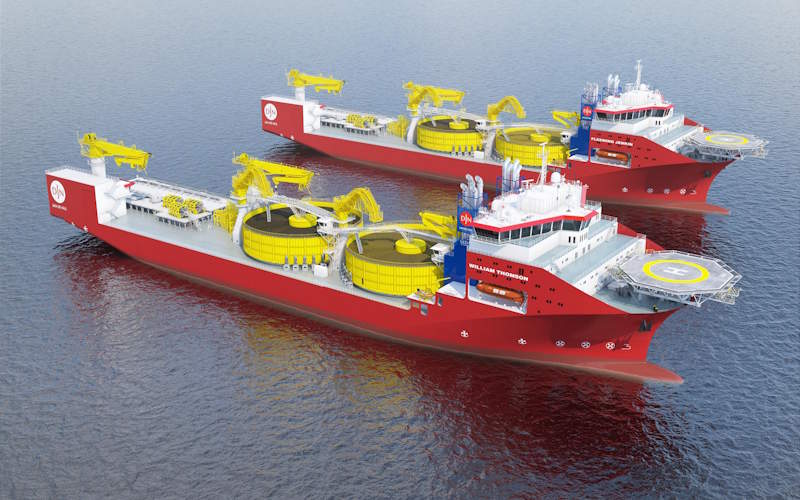
Jan De Nul has launched its next green subsea cable-laying vessel, the ‘William Thomson’, sister to ‘Fleeming Jenkin’, launched in October 2025.
Both vessels have a cargo capacity of 28,000t and a length of 215m. This makes them the largest of their kind. Both vessels were designed in-house and have been specially built to install subsea cables, both in shallow and ultra-deep waters down to 4,000m depth. Thanks to their large loading capacity, they can take longer cables on board in a single piece and bridge longer distances with as few subsea cable connections as possible. Compared to other cable-laying vessels on the market, they need to make fewer return trips to load cables. This reduces costs, minimises the environmental footprint and enhances cable quality.
Fleeming Jenkin is scheduled for delivery in the last quarter of 2026, and William Thomson will be operational in the first half of 2027.
Wouter Vermeersch, Director Subsea Cables Offshore Energy, Jan De Nul, said: “The William Thomson and her identical sister, the Fleeming Jenkin, bring together all the expertise in cable installation that we have built up over the past fifteen years. They are the highest-performing and most efficient cable-laying vessels on the market.”
The vessels are designed for ultra-low emissions, with an advanced dual exhaust filter system which removes up to 99% of nanoparticles from emissions using a diesel particulate filter and a NOx reduction system. The system significantly reduces exhaust gas pollutants. The engines of the vessel can run on biofuel and green methanol, reducing CO₂ emissions. The vessels comply with European Stage V emission standards for inland waterway vessels. Moreover, the NOx emissions are reduced to such an extent that this vessel meets the even stricter Euro VI emission limits.
The hybrid power plant on board contributes to the reduction of CO2 emissions and optimal fuel usage. It combines the generators with a 2.5 MWh battery and drive technology, designed for peak shaving, load smoothing, spinning reserve and optimised engine loading.
Jan De Nul is investing heavily in the expansion of its existing subsea cable capacity. In addition to the two vessels for installing these cables, three more vessels will be added: two trenching support vessels to bury cables in the seabed and a rock installation vessel that protects the cables with a layer of rock. This means that Jan De Nul has five additional vessels for the installation and protection of subsea cables on the way.
Vermeersch concluded:“Reliable, affordable and renewable energy, independent of geopolitical tensions, is one of the most important societal challenges of our time. With this wave of investment, we are strengthening our capacity to help build solutions.”
Image: Jan de Nul’s ultra-low emission cable laying vessels (credit: Jan de Nul)