
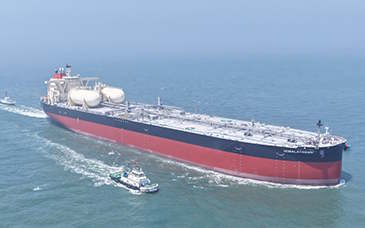
Kawasaki Heavy Industries (KHI) has delivered the ‘Himalayasan’, a very large crude oil carrier (VLCC), to Camphor Tree Maritime. The vessel was constructed at the Dalian Cosco KHI Ship Engineering (DACKS) shipyard, and operated jointly by KHI and China Cosco Shipping Corporation Limited.
The Himalayasan is the third LNG-fuelled VLCC from the Kawasaki Group. The new VLCC replaces the conventional bulbous bow with a newly designed bow form that extends the vessel’s length at the waterline, reducing wave-making resistance from bow waves during navigation, enabling greater propulsive performance. The use of a low-speed, ultra-long-stroke main engine together with a high-efficiency, large-diameter propeller provides low fuel consumption.
This vessel is equipped with a dual-fuel B&W 7G80ME-C10.5-GI-HPSCR main engine which is compatible with both LNG and LSFO. When using LNG, the emissions are expected to be reduced by around 25%-30% for CO2, 100%, for SOx and around 85% for NOx compared with conventional HFO main engines. The vessel complies with the EEDI Phase3, which regulates the CO2 emissions from VLCCs to be contracted in and after FY2025.
With the installation of SOx scrubbers at the exhaust gas outlets of the main engine and power-generation system, the vessel meets the 2020 requirements for SOx emissions. By installing this equipment, the cost for fuel oil is expected to be reduced since the conventional fuel oil will still be compatible after the regulation reinforcement.
The 310,026 dwt ship is 339.5m in length with a 352,151m3 cargo capacity. It is classed by ClassNK and will sail under the Panamanian flag.
Image: ‘Himalayasan’ dual-fuel VLCC (source: Kawasaki Heavy Industries)