
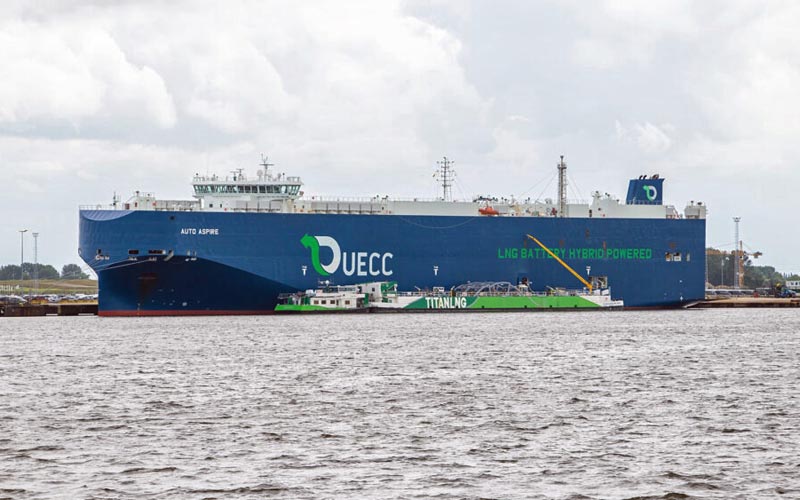
Ro-ro operator United European Car Carriers (UECC) says it achieved a significant reduction in well-to-wake CO2 emissions in 2024 mainly through bunkering high-impact liquefied biomethane (LBM) on LNG-fuelled vessels under its ‘Sail for Change’ initiative supported by major European vehicle manufacturers.
The company’s latest annual environmental data shows its emissions fell by more than 107,000t CO2e in the year, considered to represent a significant 70% increase on a reduction of over 63,000t achieved in 2023. UECC aims to boost emissions cuts by a further 50% in 2025 to nearly 155,000t towards its goal of a 187,000t reduction in 2030 as the carrier ramps up the use of alternative fuels across its eco-friendly fleet to cut regulatory costs for customers.
UECC CEO Glenn Edvardsen said: “We continue to make major strides towards realising our sustainability ambitions, supported by pioneering investments in green fuels and sustainable technologies, as well as energy efficiency measures in operations. These efforts have enabled us to provide our customers with progressively sustainable ship transport amid increasing demand for low-carbon logistics due to the imperative of decarbonisation, driven by expanding green regulation with carbon pricing and increasing penalties for pollutive operations. By taking a leading role, UECC has positioned itself ahead of the market and is firmly on track with GHG intensity reductions exceeding regulations, enabling it to run a compliance surplus in relation to FuelEU Maritime, while also cutting costs significantly under the EU Emissions Trading System (EU ETS).”
UECC’s environmental performance has been enhanced by wider adoption of alternative fuels – including biofuels, low-carbon LNG and LBM, or bioLNG – that last year accounted for around 42% of fuel consumption on its 16-vessel fleet of owned and chartered/operated pure car and truck carriers (PCTCs), up from 34% in 2023. The company has set a revised target of 58% for alternative use by 2030 due to the relatively high impact of bioLNG in cutting emissions versus other alternative fuels, allowing carbon-neutral cargo transport for customers.
The company regards bioLNG as the key fuel to achieve its target of a 45% reduction in carbon intensity by 2030 versus a 2014 baseline and net zero by 2040 – ahead of the 2050 deadline set by both the IMO and EU. The fuel is being bunkered on UECC’s dual and multi-fuel LNG PCTCs – three of which have battery hybrid capability – under ‘Sail for Change’ that was launched by UECC in 2024 and currently has participation by automotive manufacturers including Toyota, Ford and JLR. The company also has on order two multi-fuel LNG battery hybrid newbuild PCTCs due for delivery in 2028 that could be enlisted into the programme. BioLNG is considered extremely beneficial in cutting emissions due to the use of manure-based feedstock that can deliver a high impact in terms of well-to-wake emissions as required by FuelEU, taking into account extraction and processing as well as consumption.
UECC Senior Manager, Business Planning and Sustainability, Masanori Nagashima, said: “While this means there is increasing competition for the fuel in shipping, our first-mover role in procuring bioLNG puts us in an advantageous position to secure future volumes of the fuel through building relationships with suppliers.”
UECC has secured a bunkering deal with Dutch supplier Titan Clean Fuels to deliver a minimum of 12,000t of ISCC-EU certified mass-balanced LBM this year under the ‘Sail for Change’ programme.
The overall carbon intensity of the UECC fleet, using the same g CO2e/MJ (grams of CO2 equivalent per megajoule) metric as FuelEU, is calculated at 68g CO2e/MJ to achieve an interim target of a 25% carbon intensity reduction in 2025, though the company is expected to achieve 57g CO2e/MJ this year based on its supply plan, according to Nagashima. This is significantly below the current FuelEU threshold of 89.3 gCO2e/MJ – a 2% reduction from the baseline of 91.16 gCO2e/MJ – and still lower than the threshold of 77.9 gCO2e/MJ from 2035 that is a 14.5% reduction versus the baseline figure.
Nagashima said: “The low carbon intensity of our fleet means all of our vessels are expected to gain a C rating or above with the IMO’s Carbon Intensity Indicator (CII). It also gives us a significant compliance surplus under FuelEU that can be monetised through the regulation’s pooling mechanism, allowing a great commercial opportunity to offset regulatory costs for customers and eliminate FuelEU surcharges. UECC will continue to accelerate its progress in improving decarbonisation of its fleet by further optimising our fuel mix strategy going forward to incorporate more high-impact fuels as these become viable.”
Image: UECC’s multi-fuel LNG battery hybrid PCTC ‘Auto Aspire’ being refuelled with LBM at the Port of Zeebrugge (credit: Titan Clean Fuels)