
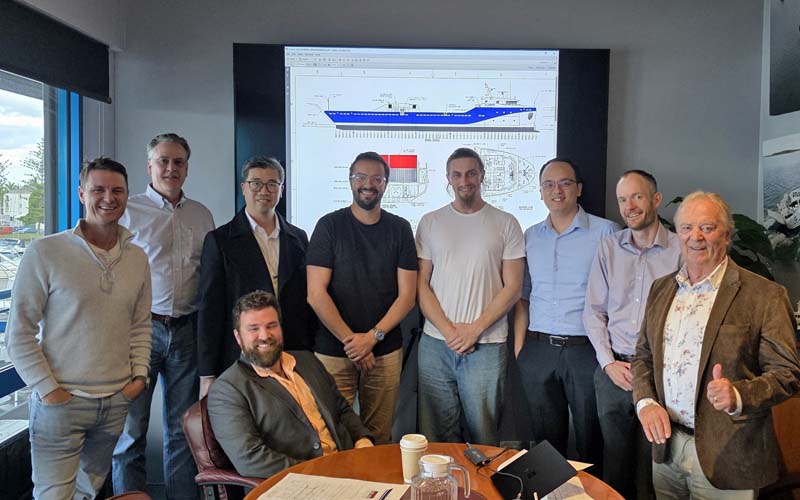
A workshop led by Lloyd’s Register (LR) has explored the integration of a modular micro reactor (MMR) into a stern landing craft vessel.
LR conducted a Hazard Identification (Hazid) workshop to evaluate the potential risks and operational factors for modular micro reactor (MMR) nuclear technology in maritime settings. This approach could pave the way for propulsion and sustainable energy solutions in remote or off-grid locations using sea-based platforms. The other participants in the workshop, ship design group Seatransport and Houston-based Deployable Energy, brought multidisciplinary experts to Seatransport’s headquarters in Australia.
The project focused on risk management strategies, safety systems, regulatory frameworks, and vessel design implications, aiming to clarify certification pathways and compliance benchmarks. With safety and regulatory integrity at the forefront, the workshop offered key insights into the feasibility and requirements for operational readiness, once the vessel meets nuclear licensing requirements.
The workshop is part of a collaboration between Seatransport, Deployable Energy and LR to develop nuclear power generation for different applications, including propulsion and strategic emergency response in remote areas. Using MMR technology, two reactors will enable the 73m stern loading vessel to operate for 8-10 years without refuelling and supply power to shore grids during port docking or in affected zones.
Matt Palmer, LR Global Nuclear and Naval Submarines Segment Director, said: “MMR technology not only reduces our dependence on traditional fossil fuels but also provides a reliable, long-term energy source that can support both operational and emergency needs in remote and underserved regions.”
Remko Hottentot, LR Commercial Manager – Australasia, added: “By bringing together leading experts in the field, we have not only identified the key challenges but also outlined strategic solutions to overcome them. These will now be incorporated into the vessel design. This collaborative effort has significantly strengthened our partnership and set a clear path for future advancements using MMR technology for sustainable maritime energy solutions.”
Dr Stuart Ballantyne, Chairman, Seatransport, said: “In my many years advocating nuclear propulsion, I believe now for commercial ships it is within reach and will be commonplace by 2030. My thanks for all visionaries working in this space.”
Bobby Gallagher, CEO and CTO Deployable Energy, concluded: “Deployable Energy is proud to be advancing toward approval-in-principle for the hybrid-powered stern landing vessel. Powered by our 1MW unity nuclear battery, this next-generation vessel runs cheaper than conventionally fuelled ships, using safe, standard fuel with no exotic materials. Deployable Energy is delivering clean, scalable energy to transform shipping, resource production, and heavy industry.”
Image: Participants at the MMR workshop in Australia (source: Lloyd’s Register)