
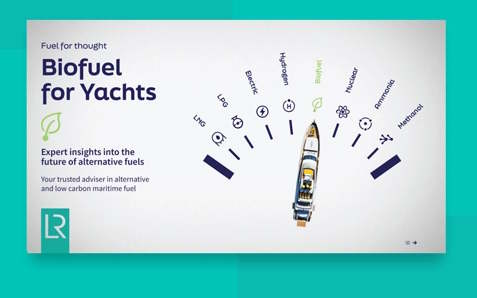
Lloyd’s Register (LR) has released the latest edition of its Fuel for Thought series, ‘Fuel for Thought: Biofuels for Yachts’, highlighting the role of biofuels in the superyacht sector’s energy transition.
This latest report positions hydrotreated vegetable oil (HVO) as a practical, drop-in alternative to conventional marine fuels. With mounting pressure to reduce GHG) emissions, particulate matter and SOx, HVO is seen to be emerging as a leading drop-in solution. It delivers significant environmental benefits without compromising performance or requiring major technical modifications, making it an attractive alternative for yacht owners, captains and management companies.
This edition of Fuel for Thought explores the opportunities and limitations of biofuels for use in yachting. It provides practical guidance on safety, toxicity, bunkering logistics, fuel quality and regulatory frameworks. The report examines lifecycle emissions, market demand, economic factors and the supply chain, alongside insights into engine compatibility and NOx emissions.
The analysis shows that biofuels share similarities with fossil fuels, allowing the use of established industry practices operating with petroleum distillates. HVO, produced through hydrotreatment, can directly replace MGO, offering better stability and combustion. Its drop-in capabilities enable ships to cut CO2 emissions cost-effectively, even if they cannot be fully retrofitted for fuels like methanol or ammonia.
The report confirms that safety requirements for transporting, handling, and bunkering liquid biofuels are generally similar to those for fossil-derived fuels. While the report underlines the role of biofuels as a practical near-term step, it stresses that they are not a complete solution. A wider strategy, including energy efficiency, sustainable design and alternative propulsion technologies, will be vital for long-term progress.
LR’s specialist services, including its Biofuel Advisory service, help shipowners, fuel suppliers and producers adopt biofuels safely and at scale. The new service is designed to remove uncertainty for the industry by providing end-to-end support across the biofuel supply chain, from production and certification through to delivery and onboard use. Additionally, LR’s fuel oil bunker analysis service (Fobas), can support customers by offering bespoke testing programmes to guarantee quality and trouble-free operations.
Engel de Boer, Global Yacht Segment Manager, LR, said: “The challenge is not whether the yachting industry will decarbonise, it’s how quickly it can. Unlike past transitions driven by technological innovation or commercial advantage, today’s energy shift is propelled by environmental urgency, regulatory mandates and rising social expectations. By providing evidence-based insight and clear advice, LR is dedicated to providing trusted advice and leading the yachting industry safely and sustainably through this energy transition.”
The full Fuel for Thought: Biofuels for Yachts report is available to download here.