
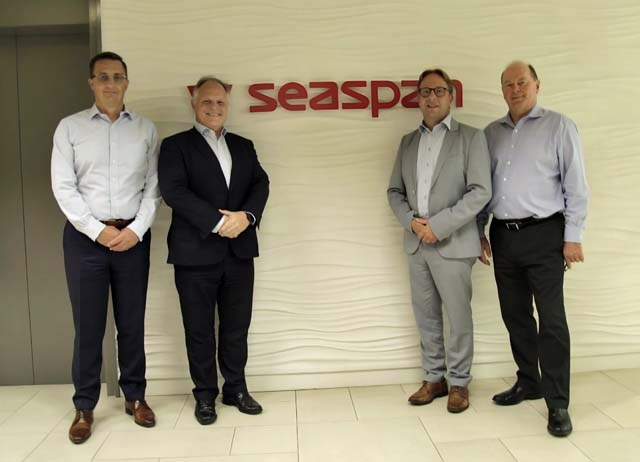
MAN Energy Solutions has signed a Conversion Commitment Agreement with Seaspan Corporation (Seaspan),a containership ownership and management company in collaboration with global liner shipping company Hapag-Lloyd, under which MAN PrimeServ, MAN Energy Solutions’ after-sales division, will deliver 15 engine retrofit solutions.
The vessels to be converted are powered by MAN B&W S90-type fuel-oil-powered engines from the Seaspan and Hapag-Lloyd fleets, which will be upgraded to dual-fuel ME-LGIM engines capable of running on green methanol. The Agreement includes 45 optional engine retrofit solutions. Each conversion can provide a CO2 reduction of 50,000t–70,000t each year when operating on green methanol.
The development of this solution opportunity was led by Thomas Leander MAN PrimeServ Head of Solutions and Site Manager Frederikshavn, Peter Curtis of Seaspan and Richard von Berlepsch, MD Fleet of Hapag-Lloyd.
Seaspan is the largest global containership lessor, primarily focused on long-term time charters with leading container shipping lines. With a newbuild programme of 70 vessels, Seaspan will bring its owned fleet to a total of 200 vessels and 1.9m TEU capacity. With a fleet of 250 modern container ships and a total transport capacity of 1.8m TEU, Hapag-Lloyd aims at operating its vessels in a climate-neutral manner to become net-zero carbon by 2045.
Leander said: “Seaspan and Hapag-Lloyd are significant maritime stakeholders with strong fleet-decarbonisation commitments and strategies. This Agreement shows clear intent to drive the industry transition toward zero-carbon shipping. Retrofitting existing engines to dual-fuel running is one of the most effective ways to reduce greenhouse gas emissions and to derive greater efficiency and profitability from an existing shipping fleet, while simultaneously delivering fuel flexibility and extending operational lifetimes. Crucially, this also avoids the unnecessary building of additional tonnage with associated CO2 emissions, and thereby showcasing that retrofitting the existing maritime fleet is an important and feasible path. With this collaborative agreement, we proceed our journey providing decarbonisation solutions for the maritime industry.”